An idea management program is a strategic innovation and continuous improvement framework, designed to capture ideas and insights from a company’s own employees.
By tapping into internal talent, organizations can solve real-world business challenges, streamline workflows, and pave the way for next-generation products and processes.
This initiative serves as an internal improvement engine that empowers employees to generate, share, and implement creative business solutions.
The core objective of this model is to give your team a voice, transforming every employee into an active contributor capable of driving bottom-line value.
In this comprehensive guide, we explore the origins of the idea management program, its measurable business benefits, and the complete playbook on how to structure one to achieve concrete ROI in your organization.
Table of Contents
Listen to a summary of this article (in English):
What is an Idea Management Program?
An idea management program is a structured innovation and continuous improvement tool used to collect, evaluate, and execute employee insights. It addresses actual corporate pain points, optimizes operational efficiency, and helps design new offerings.
A high-performing program does not just accumulate suggestions, but actively builds business value. Whether your goals include cost reduction, enhanced operational efficiency, scalable workflows, higher customer satisfaction, or net-new revenue streams, each can serve as the baseline for targeted innovation campaigns.
To succeed, an idea management program requires sustained engagement and active participation. While technology provides the infrastructure, people are the true engines of corporate innovation. To keep this engine running, organizations must commit to recognizing and motivating their teams.
The Evolution of Structured Idea Management
The concept of structured ideation is far from brand new. Historical milestones range from early suggestion boxes in 18th-century Edo-period Japan to Eastman Kodak’s formalized employee suggestion system introduced in 1898.
The underlying driver has always been identical: unlocking collective intelligence to capture a competitive edge.
Following World War II, structured ideation rapidly gained traction across the corporate landscape. As the sheer volume of employee submissions grew, enterprises faced a new logistical hurdle: how to systematically track and evaluate these insights.
In today’s corporate vocabulary, you might hear this strategy also referred to as an Employee Suggestion System, an Internal Innovation Campaign, or an Intrapreneurship Program.
Regardless of the terminology, the objective remains the same: building a continuous pipeline of innovation and incremental improvements to sustain market differentiation.
Market shifts dictate new customer needs, which inspire internal ideas. These ideas turn into targeted R&D and marketing campaigns, which ultimately capture more market share.
Models of Idea Management Programs
Modern corporate innovation and continuous improvement methodologies generally stem from two primary historical frameworks: the Western Model and the Eastern Model.
The Western Model
The Western model, frequently tied to traditional corporate structures in the US and Europe, focuses heavily on capturing “the next big thing.”
- Incentive Structure: heavily relies on financial rewards. Employees are often compensated with flat-rate bonuses or a specific percentage of the cost savings/revenue generated by the implemented idea.
- Evaluation Process: submissions undergo rigorous financial and technical feasibility reviews by senior executives. Executive approval is mandatory before any project secures funding.
- Execution: once greenlit, the idea transforms into a formal, high-priority project with fixed timelines, dedicated budgets, and strict KPIs.
Because this framework filters out low-impact suggestions early on, day-to-day administration requires fewer resources, allowing companies to run it independently of their core management style.
The Eastern Model
The Eastern model, deeply rooted in the Japanese philosophy of Kaizen Teian (continuous improvement/continuous suggestion), prioritizes widespread, voluntary participation over individual financial windfalls.
- Incentive Structure: relies primarily on symbolic rewards, public recognition, and career advancement tokens to reinforce internal teamwork.
- Evaluation Process: rather than hunting exclusively for disruptive breakthroughs, this model welcomes small, incremental changes designed to optimize daily operational environments.
- Execution: frontline managers and local committees hold the autonomy to approve and implement solutions rapidly, fostering an organizational culture of collective knowledge accumulation.
Which Model Fits Your Business Best?
Choosing the right framework requires an objective look at your corporate culture. For an idea management program to deliver, evaluate these four pillars:
- Strategic Alignment: ensure the core objectives of your ideation campaigns directly support your broader corporate strategy.
- Reward Mechanism: tailor rewards (financial bonuses vs. public recognition or gamified perks) to match what actually motivates your workforce.
- Participant Pool: decide whether to limit submissions to specific engineering or product teams (Western approach) or open the doors to the entire workforce. The AEVO Innovate methodology advocates for democratized ideation, allowing every employee, from the front lines to the C-suite, to submit ideas.
- Approval Workflows: avoid administrative bottlenecks. If your program relies on complex ideas, structure a streamlined review committee to keep momentum high.
We highly recommend having both models applied at your company’s program, structured in the same idea management software, like AEVO Innovate, but with different workflows. If you want to know how to run this kind of initiative, schedule a personalized demo with us.
Why Your Business Needs an Idea Management Program
Investing in a dedicated innovation system yields multiple organizational benefits:
- 1. Enhanced Employee Retention & Belonging: employees want to see meaning in their daily work. When an employee submits an idea, watches it come to life, and gets recognized for its business impact, their alignment with corporate culture skyrockets.
- 2. Fast-Tracked Product Development: frontline workers (customer success reps, account executives, and support agents) interact with your market daily. They are your best resource for gathering immediate customer feedback and converting it into product enhancements.
- 3. Sustainable Workspace Engagement: a robust innovation culture turns passive employees into proactive intrapreneurs who treat the company’s long-term growth as their own.
- 4. Process Optimization: focused ideation campaigns can eliminate operational bottlenecks, reduce manual work, and free up your teams to focus on high-value, strategic initiatives.
- 5. Gamified Employee Well-Being: partnering with HR to introduce gamified leaderboards turns program participation into a healthy, collaborative competition that rewards creative thinking.
- 6. Resource and Cost Optimization: employee-driven ideas often highlight hidden resource drains, enabling companies to optimize supply chains or pivot toward sustainable, ESG-compliant practices.
- 7. Market Pioneer Status: true market differentiation comes from within. Moving quickly on internal insights allows your business to set industry trends rather than chasing competitors.
- 8. Elevated Brand Equity: consistently rolling out customer-centric innovations enhances your brand’s reputation, positioning your enterprise as an industry benchmark.
- 9. Activating Frontline Potential: as Alan Robinson and Dean Schroeder note in “The Idea-Driven Organization” (2014), close to 80% of an organization’s improvement potential walks in the door every day with frontline workers. An idea management program provides the structured venue required to capture this value at scale.
How to Structure Your Idea Management Program
To help companies scale their innovation efforts, AEVO Innovate developed the Intrapreneurship Canvas, a framework validated by leading global innovation consultancies. The model rests on three distinct pillars:
Pillar 1: Strategy
Focus on a central question: how will this program generate tangible business value?
- Success Metrics: determine your primary KPIs. Are you tracking hard financial return (ROI), or is your initial goal centered on the volume of implemented ideas?
- Challenges: map out the exact organizational hurdles or market opportunities you want your workforce to tackle.
Pillar 2: Engagement & Change
An innovation program cannot succeed in a cultural vacuum. You need to leverage clear change-management levers to shift traditional employee mindsets:
- Awareness: build a multi-channel communication plan (interactive launch events, Slack/Teams updates, workplace signage) tailored to your environment.
- Reinforcement Processes: align individual performance goals with program participation, and back them up with compelling incentives.
- Skill Building: provide your team with foundational training in design thinking, problem framing, and modern technologies.
- Leadership Roles: secure active buy-in from all levels of management. Teams adopt new habits when they see their direct leaders actively participating.
Pillar 3: Execution Capacity
Ideas lose value if they sit in a backlog. To maintain momentum, segment submissions into two categories:
- Simple Ideas: low-cost, low-risk improvements. Empower local continuous improvement committees to approve and execute these quickly. Fast turnarounds demonstrate corporate commitment and turn standard contributors into enthusiastic program ambassadors.
- Complex Ideas: high-impact suggestions that require dedicated budgets, cross-departmental labor, and extended timelines. Secure a transparent innovation fund ahead of time to keep these projects moving forward without red tape.

Click here to access the full Intrapreneurship Canvas, a framework designed to help your company create an effective idea management program.
Best Practices for Maximizing Performance and ROI in your idea management program
To turn your ideation platform into an efficient business engine, build these daily operational habits:
1. Run Targeted Innovation Campaigns
Instead of asking for general suggestions, launch time-bound campaigns focused on precise problems (e.g., “How can we reduce churn in user segment X?” or “How do we trim 10% off our logistics cycle?”).
2. Establish Objective Evaluation Criteria
Vague evaluation metrics kill engagement. Define explicit evaluation stages, assign clear ownership, and share timelines transparently so contributors always know where their submissions stand.
3. Leverage the Innovation Funnel
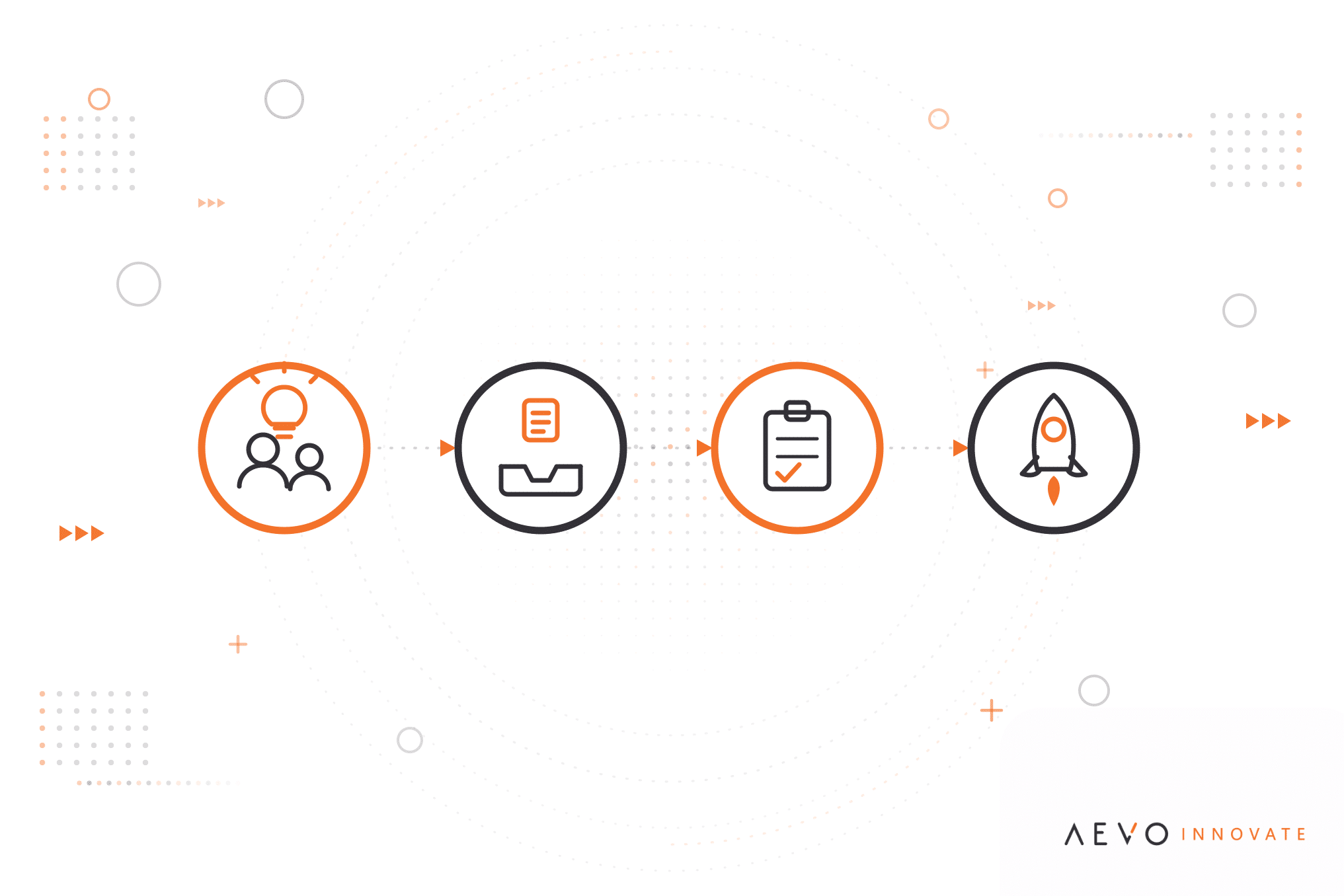
Guide every submission through a standardized pipeline: Ideation / Campaign Launch > Concept Refinement > Feasibility Review > Active Execution.
4. Foster Open Collaboration
Choose an idea management software that supports social collaboration, like AEVO Innovate. Allowing colleagues to comment on, refine, and co-author submissions helps polish rough concepts before they ever reach an evaluation committee.
5. Deploy Dedicated Idea Management Software
Managing spreadsheets and email threads quickly becomes unsustainable. Using a dedicated platform helps you centralize, track, and scale your initiatives smoothly.
The AEVO Innovate Idea Management Platform delivers an enterprise-grade toolkit to streamline your entire innovation lifecycle:
- Targeted Campaign Launches: easily deploy specific corporate innovation challenges.
- AI Writing Assistant: assist users in articulating their thoughts. AI helps refine, organize, and improve the clarity of every form field.
- Alignment Scoring (Submission): instant feedback on how well an idea fits the specific campaign’s goals during the drafting phase.
- Social Ideation Feeds: enables cross-departmental collaboration via likes, threads, and peer reviews.
- Expert Evaluation Workflows: routes concepts to designated specialists for technical feedback.
- Auto-Translation: break language barriers in global programs with seamless, automated translation for international teams.
- Financial ROI Tracking: centralized dashboards monitor the real-world financial impact of every implemented project.
- Gamified Ecosystems: integrated points and rewards systems to sustain long-term employee engagement.
Real-World Success Stories

Global manufacturing leader BIC successfully replaced passive suggestion systems with a high-velocity engine called BICUp!, scaling operational excellence across more than 11 factories worldwide.
By shifting away from rigid corporate programs to focus on an agile culture of trust and autonomy, the initiative engages thousands of frontline workers to identify and eliminate manufacturing inefficiencies.
The program’s global expansion rejected generic “copy-and-paste” rollouts in favor of controlled decentralization, allowing individual plants to adapt the framework to their unique cultural strengths, such as BIC Tunisia utilizing its natural energy for open discussion to generate over 200 ideas in its first week.
Central to sustaining and scaling this global operational engine across multiple international plants is the AEVO Innovate platform, which provides essential governance, transparency, and tracking capabilities.
By centralizing submissions into a structured architecture, the software has driven unprecedented workplace engagement, leading to a staggering 97% employee participation rate in regions like Brazil where workers implement at least 12 ideas per year.
This structured collaboration converts raw grassroots insights into a repeatable 3% to 5% annual reduction in operational waste, which offsets inflation and delivers millions of euros in confirmed bottom-line ROI.
Conclusion
A well-executed idea management program acts as a reliable catalyst for measurable business growth. By giving your workforce a structured voice and equipping your managers with tools like the AEVO Innovate Platform, you can convert raw creativity into clear competitive advantages.
Here’s a video for you with 7 steps to build an idea management program that actually works:
Frequently Asked Questions (FAQ)
What is the difference between an idea management program and a traditional suggestion box?
Traditional suggestion boxes are passive, unmonitored tools where ideas frequently go unanswered due to a lack of feedback loops. An idea management program is a structured framework that uses dedicated software, clear evaluation stages, transparent KPIs, and active management to guide concepts from initial submission to final implementation.
How can we keep employees engaged in the idea program long-term?
Long-term engagement relies on transparency, quick feedback, and clear recognition. Use gamified elements like leaderboards and peer collaboration features, ensure managers review submissions quickly, and celebrate every successful implementation publicly.
Can non-technical employees participate in corporate ideation campaigns?
Absolutely. Most high-impact operational improvements come from frontline staff who handle daily workflows. A modern idea management strategy democratizes innovation, ensuring that every team member—regardless of department or technical background—can submit ideas and collaborate.