Continuous improvement is a management practice focused on the ongoing enhancement of products, processes, and services. It works as a cycle of analyzing workflows, identifying flaws, and implementing solutions that maximize productivity and operational efficiency.
More than just a method, it represents a mindset. When well implemented, it drives measurable results, strengthens operational excellence, and supports long-term innovation.
In this article, you’ll learn what continuous improvement is, its three core pillars, why it matters, how it differs from Kaizen and other methodologies, and how global organizations apply it to generate measurable business results.
Table of Contents
Listen to this blogpost’s summary here:
What is continuous improvement?
Continuous improvement is a structured effort to make incremental enhancements in products, processes, and services. It involves continuously analyzing business performance, identifying weaknesses, and proposing targeted improvements that can increase efficiency and long-term success.
Many well-established companies struggle to adapt when faced with technological change, operational complexity, or growing competition. A continuous improvement approach helps organizations stay agile and aligned with changing market demands.
The objective is not simply to make processes faster. It is to create a repeatable system in which teams can identify opportunities, test improvements, measure their impact, and standardize what works.
This makes continuous improvement particularly relevant to organizations pursuing operational excellence, employee engagement, cost reduction, quality improvement, and sustainable growth.
Read more: Building a Continuous Improvement Culture: why consistency beats the “big breakthrough”
Where does the term continuous improvement come from?
The idea of continuous improvement has roots in quality management and manufacturing practices that evolved throughout the 20th century. One of its strongest corporate references is the Toyota Production System, which incorporated continuous improvement into the way work is designed, monitored, and improved.
Toyota’s approach is closely associated with Kaizen, which Toyota describes as a commitment to continuously improving business operations. The company also connects Kaizen with the knowledge and participation of employees working directly in processes.
Over time, continuous improvement expanded beyond manufacturing and became a broader management discipline applied across industries, including services, healthcare, technology, logistics, telecommunications, and financial services.
The 3 pillars of continuous improvement
Although strategies vary by company, successful continuous improvement programs generally depend on three interconnected pillars:
1. People and culture
Continuous improvement starts with the people closest to the work.
Employees need a clear channel to identify problems, suggest improvements, collaborate on solutions, and understand what happens to their contributions.
A strong improvement culture therefore encourages participation, transparency, recognition, and accountability. Instead of expecting managers to identify every opportunity, organizations create mechanisms for employees across different levels to contribute.
2. Processes and methodology
Ideas alone do not create improvement. Organizations need structured processes to evaluate opportunities, test solutions, implement changes, and standardize successful practices.
Frameworks such as PDCA, Kaizen, Lean, and Six Sigma provide different ways to structure this work depending on the problem and organizational context.
3. Measurement and learning
Continuous improvement must be measurable.
Teams need to establish baselines, define KPIs, monitor results, and determine whether an intervention actually improved performance.
This creates a feedback loop:
Identify → Improve → Measure → Learn → Standardize → Improve again
When these three pillars work together, continuous improvement becomes part of everyday operations rather than an isolated initiative.
Why continuous improvement is important
Continuous improvement supports operational excellence by encouraging employees to find efficiency opportunities in their daily work.
From small adjustments, such as improving communication templates, to larger initiatives involving customer service, production, logistics, or technology, every improvement can contribute to organizational performance.
By analyzing workflows and optimizing them, companies can make decisions based on real data and create more sustainable improvements.
The benefits extend externally as well, often resulting in:
- Higher customer satisfaction
- Better product and service quality
- Lower operational costs
- Reduced waste
- Greater productivity
- Stronger employee engagement
- Faster response to change
- Improved competitiveness
The cumulative effect is important. A single small improvement may have limited impact, but hundreds or thousands of improvements implemented consistently across a large organization can generate significant operational and financial value.
Continuous improvement vs. Kaizen: what’s the difference?
Continuous improvement and Kaizen are closely related, but they are not exactly the same concept.
Continuous improvement is the broader management philosophy of systematically identifying and implementing improvements over time.
Kaizen is a Japanese approach centered on continuous, incremental improvements, with strong emphasis on employee participation and improvements made close to where the work happens.
Toyota is one of the best-known examples of Kaizen in practice. Its corporate philosophy describes Kaizen as continuously improving business operations while involving people throughout the organization.
In practical terms:
- Continuous improvement defines the broader objective and management discipline.
- Kaizen provides a philosophy and way of working centered on incremental improvement.
- Organizations can use Kaizen as one component of a broader continuous improvement strategy.
Continuous improvement vs. Kaizen vs. Kanban vs. Six Sigma/DMAIC
These approaches are often mentioned together, but they solve different problems and operate at different levels.
| Approach | Core concept | Main focus | Typical use |
| Continuous Improvement | Ongoing effort to improve processes, products, and services | Long-term organizational improvement | Company-wide improvement programs |
| Kaizen | Continuous, incremental improvement involving employees | Daily improvements and operational culture | Frontline processes, waste reduction, workplace improvements |
| Kanban | Visual management of workflow and work in progress | Flow, prioritization, and bottleneck reduction | Operations, projects, service workflows, improvement initiatives |
| Six Sigma / DMAIC | Data-driven problem solving through Define, Measure, Analyze, Improve, Control | Process variation, defects, and measurable performance | Complex quality and process improvement projects |
DMAIC is particularly structured around improving existing processes that do not meet performance standards or customer expectations. The American Society for Quality identifies its five phases as Define, Measure, Analyze, Improve, and Control.
Six Sigma and Lean also differ in emphasis: Lean primarily focuses on waste reduction and flow, while Six Sigma emphasizes reducing process variation through data and statistical analysis.
The approaches can therefore complement one another rather than compete.
For example, a company could use continuous improvement as its overarching strategy, Kaizen to engage frontline employees, Kanban to manage improvement initiatives, and DMAIC to solve complex process problems.
How to implement continuous improvement
While many companies recognize the need for improvement, they often struggle to know where to start. Here are some practical steps for implementing a continuous improvement strategy:
1. Define your focus
Clarity is key. Focused efforts lead to meaningful results.
Start by identifying critical areas that need improvement. These focus points vary by company but are the foundation for any continuous improvement journey.
Look for recurring bottlenecks, quality issues, customer complaints, unnecessary costs, safety concerns, excessive waiting time, or tasks that consume resources without creating proportional value.
2. Measure performance
Performance tracking is essential. You can’t improve what you don’t measure.
Use objective metrics to assess outcomes:
- Have sales increased?
- Are customers more satisfied?
- Is employee engagement rising?
- Has waste decreased?
- Has cycle time improved?
- Have operational costs been reduced?
Track indicators such as error reduction, faster deliveries, lower rework, or higher conversion rates to monitor real progress.
3. Standardize processes
Standardization ensures consistency and quality.
By standardizing workflows, service protocols, and communication patterns, companies can operate more efficiently and predictably.
Once an improvement proves successful, documenting and standardizing the new process also prevents teams from gradually returning to the previous way of working.
Lear more: The complete playbook for creating an idea management program
4. Create a structured improvement pipeline
Organizations need more than isolated suggestions. They need a clear path for moving improvement opportunities from identification to implementation.
A structured process can include:
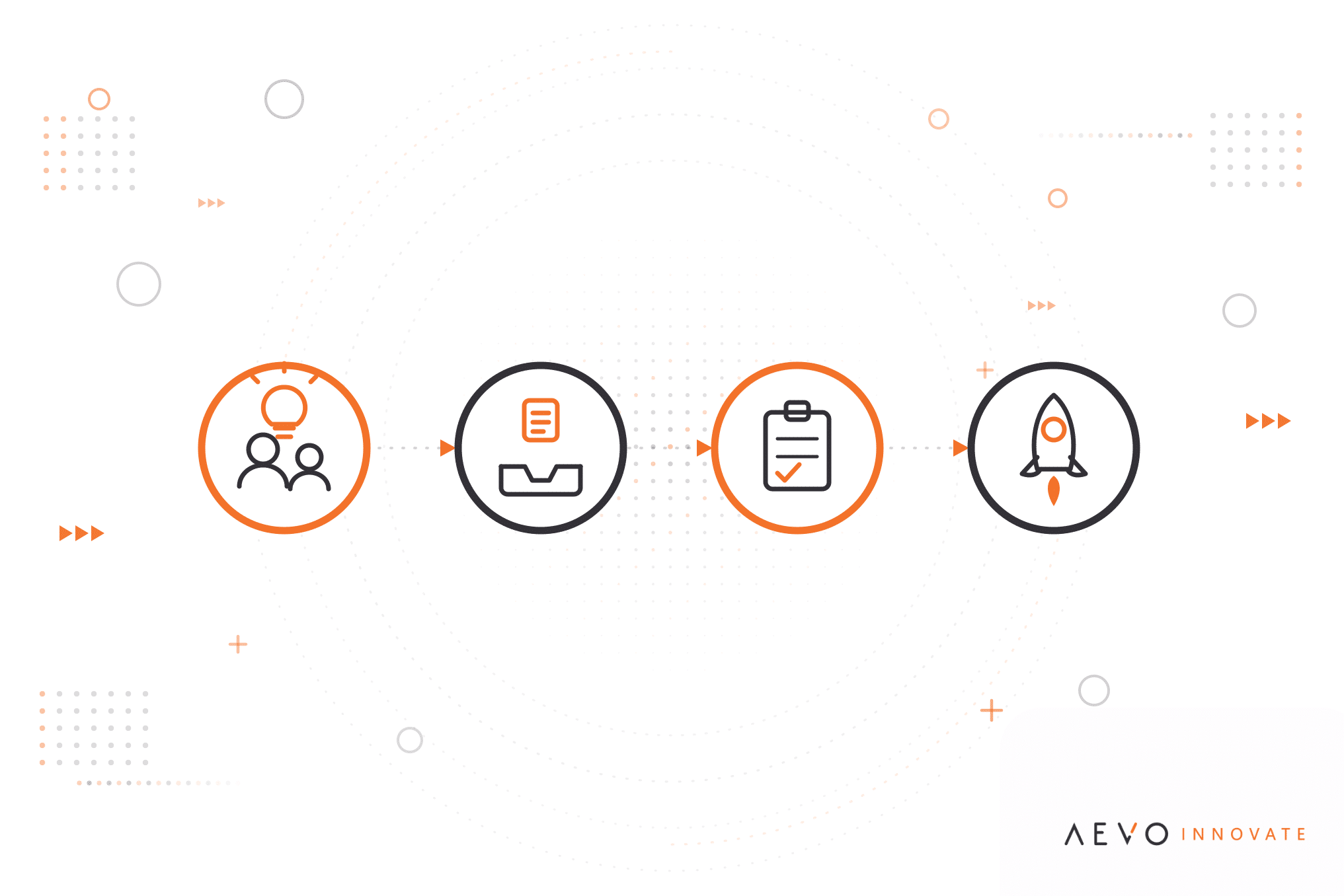
Opportunity identification → Idea submission → Evaluation → Prioritization → Implementation → Measurement → Standardization
This creates visibility into what is being improved, who owns each initiative, and what results have been achieved.
Read more: Best practices to generate effective Business Improvement Ideas
Continuous improvement tools
Several tools can support your continuous improvement strategy:
- PDCA Cycle (Plan, Do, Check, Act)
- Six Sigma
- Kaizen Method
- Ishikawa Diagram (Fishbone)
- 5W2H Analysis
- SWOT Matrix
The right tool depends on the type of problem being addressed. Some help teams understand root causes, others structure experiments, while methodologies such as Lean and Six Sigma provide broader systems for managing improvement.
Let’s take a closer look at one of the most popular tools.
The PDCA cycle in continuous improvement

The PDCA Cycle is a foundational method for driving continuous improvement.
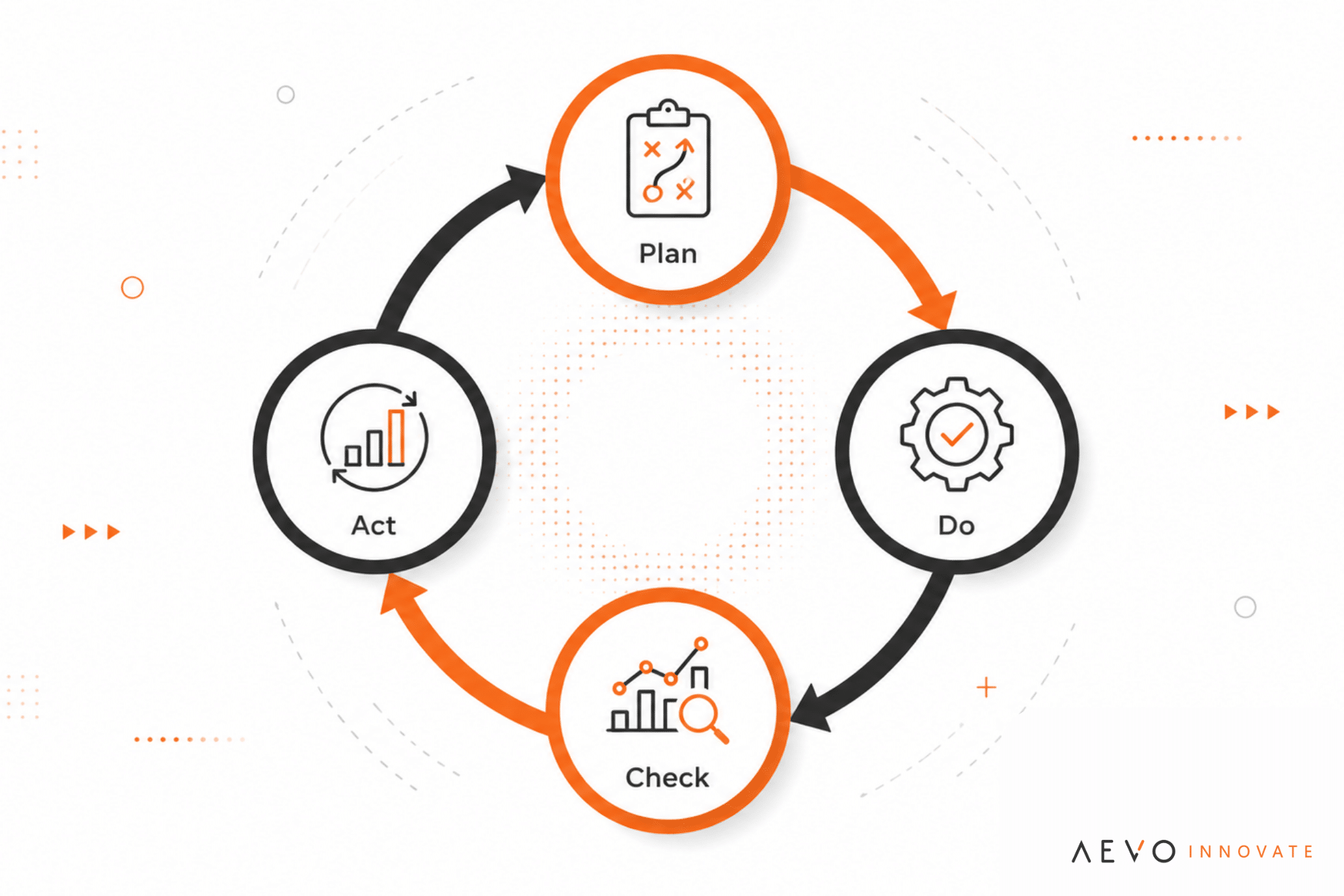
PDCA stands for:
- Plan – define the strategy
- Do – implement the plan
- Check – monitor and measure results
- Act – take corrective action and standardize what works
The cycle supports short-term improvements while building a long-term organizational culture based on experimentation, measurement, and learning.
Read more: Continuous Improvement Cycle: what it is, the 4 pillars, and key benefits
The value of the PDCA cycle
PDCA introduces a never-ending loop of progress.
Unlike one-off initiatives, it creates a repeatable process for constant optimization.
It can start small, such as standardizing email responses or reducing unnecessary approval steps, and scale into more complex transformations involving production, logistics, customer service, or technology.
The fundamental logic remains the same:
Plan → Do → Check → Act → Repeat
The four phases of PDCA
Each stage of the PDCA cycle contributes to long-term continuous improvement:
Plan: Identify the problem or opportunity, understand its causes, establish objectives, and define how success will be measured.
Do: Implement the proposed solution, preferably on a controlled or limited scale when possible.
Check: Compare the results against the initial baseline and determine whether the change produced the expected improvement.
Act: Standardize successful changes, address remaining gaps, and begin a new improvement cycle.
PDCA vs. PDSA: what’s the difference?
In 1986, W. Edwards Deming introduced the PDSA cycle: Plan, Do, Study, Act, as an evolution of PDCA. The key change was replacing “Check” with “Study.”
Rather than simply verifying outcomes, the “Study” phase encourages deeper analysis of what worked, what did not, and why.
While Deming distinguished PDSA from PDCA, both models can serve as valuable tools for continuous improvement. Companies can choose the approach that best fits their improvement goals.
Using PDCA in your company
The PDCA cycle is not a standalone tool. It must be integrated into your company’s broader continuous improvement strategy.
By building a culture of constant feedback and learning, your team will begin to see improvement as a natural and necessary part of everyday work.
Digital management can reinforce this process by making improvement opportunities, responsibilities, workflows, and results visible across the organization.
Real-world examples of continuous improvement
Here’s how major organizations are applying continuous improvement to achieve real results:
BIC
With 11 factories worldwide, BIC uses AEVO Innovate to power its continuous improvement strategy.
The BICUp! program engages more than 8,000 employees across its operations, creating a structured channel for ideas focused on efficiency and improvement.
Key results:
- 11 factories connected
- 8,000 employees engaged
- 50,000+ ideas submitted
- 30,000 ideas implemented
- Up to 90% employee engagement
The case illustrates how a structured digital platform can connect frontline participation with a global continuous improvement strategy.

Scholle IPN
Scholle IPN, a global leader in flexible packaging, adopted AEVO Innovate to embed continuous improvement into its culture, even without a formal innovation department.
By leveraging the multidisciplinary strengths of its team, the company aligned improvement efforts with daily operations and made innovation a shared responsibility.
This model demonstrates that continuous improvement does not need to sit within a dedicated innovation function. It can become part of the way operational teams identify and solve problems.
Vivo
Vivo, part of the Telefónica Group, operates a large-scale telecommunications business supported by physical stores and digital customer service channels.
The company uses Lean Six Sigma to drive continuous improvement through an innovation program created in 2012 and currently managed through AEVO Innovate.
The program combines training, practical application, project development, and certification. Employees identify problems and bottlenecks in their own areas, develop improvement projects, and progress through different Lean Six Sigma certification levels.
The program includes Yellow Belt, Green Belt, Black Belt, and Innovation Belt tracks, covering projects with different levels of complexity and duration.
The scale of employee participation is one of the program’s strongest characteristics:
- 13,000+ employees have completed Belt certifications.
- Participation represented approximately 40% of the workforce by 2023.
- More than 1,000 projects are implemented annually.
- Projects generate approximately R$150–200 million in financial returns per year.
- The program has reached approximately 40% engagement with innovation and continuous improvement initiatives.
As Gustavo Mendes, People Management Analyst at Vivo, explains:
“Results is a topic that makes our eyes shine. Here at Vivo, we validate all results with the controller area, and it varies a lot depending on the number of projects we have in the year, but we have an average of R$150 to R$200 million in financial returns from innovation projects per year.”
The case demonstrates how Lean Six Sigma, employee participation, structured certification, and digital management can work together to turn continuous improvement into a measurable business program.
Toyota
Toyota is one of the most recognized examples of continuous improvement.
The company’s production philosophy is closely associated with Kaizen, which Toyota describes as a continuous effort to improve business operations and drive innovation and evolution.
Toyota’s approach demonstrates an important principle of continuous improvement: even organizations with highly mature operations can continue looking for better ways to work.
As continuous improvement programs grow, managing them through spreadsheets, emails, and disconnected workflows becomes increasingly difficult.
How technology supports continuous improvement
A digital platform can centralize:
- Idea submission
- Evaluation and prioritization
- Improvement projects
- Responsibilities and approvals
- KPIs
- Implementation status
- Financial impact
- Portfolio visibility
This becomes especially important for organizations operating across multiple teams, sites, or countries.
A structured digital environment allows leadership to maintain governance while giving employees a clear and accessible way to participate.
AEVO Innovate for continuous improvement management
AEVO Innovate is designed to help organizations structure and manage innovation and continuous improvement programs at scale.
The platform connects idea generation, evaluation, project execution, and impact measurement, allowing improvement opportunities to move from employee contributions to structured initiatives and measurable outcomes.
Its capabilities include idea management, customizable workflows, project and initiative management, dashboards, KPI tracking, and AI-powered support across the innovation funnel.
For continuous improvement programs, this means organizations can create a structured environment where employees submit opportunities, managers evaluate and prioritize them, teams execute approved initiatives, and leadership tracks the resulting impact.
AEVO Innovate also supports operational excellence programs by helping organizations manage improvement initiatives across teams and sites while maintaining visibility over KPIs, cycle times, and ROI.
Explore AEVO Innovate for continuous improvement and operational excellence
Before you go, here is a summary video that puts all the concepts you just learned together.
Conclusion
Continuous improvement is not about making one major change and moving on. It is about creating a system that makes improvement repeatable, measurable, and part of everyday operations.
The strongest programs combine three elements: people who are empowered to identify opportunities, processes that turn those opportunities into action, and measurement that proves whether the change created value.
Frameworks such as PDCA, Kaizen, Lean, and Six Sigma provide practical ways to structure this work. But methodology alone is not enough. Organizations also need the governance, visibility, and infrastructure to manage improvement at scale.
That is where digital management becomes valuable.
AEVO Innovate helps organizations connect employee ideas with structured improvement initiatives, execution workflows, KPIs, and measurable results — creating a continuous improvement system that can scale across teams and operations.
See how AEVO Innovate can help your organization manage continuous improvement at scale.