Creative problem solving is more than a brainstorming exercise. In high-performance organizations, it becomes a repeatable system for reframing challenges, uncovering unconventional solutions, and generating measurable business value.
Imagine a startup navigating a financial crisis. Instead of cutting staff or lowering product quality, the team reframes the challenge: How do we maintain service excellence while reducing costs? Through a structured creative problem solving session, the company uncovers non-obvious efficiencies and even uses the crisis to redesign internal processes that later become a competitive differentiator.
This is the true power of creative problem solving. Not only solving an immediate issue but accelerating innovation, strengthening culture, and unlocking long-term strategic advantage.
In this article, we go deeper than the basics. You’ll learn how organizations apply creative problem solving at scale, which techniques actually generate results, and how companies like 3M, LEGO, and Scholle IPN leverage these methods to drive transformation.
Table of Contents
Here is a summary audio of today’s reading:
What Is Creative Problem Solving (CPS)?
Creative problem solving refers to the ability to explore challenges through new perspectives, identify opportunities beyond the obvious, and generate solutions that break from conventional thinking.
Originating in the 1950s with Alex Osborn (author of Applied Imagination) CPS evolved from a technique for advertising creativity into a robust organizational methodology. Today, CPS is essential in environments marked by complexity, uncertainty, and constant disruption.
More importantly, CPS is no longer a “nice to have” skill. It is a core business capability.
Why Creativity Matters in Problem Solving
1. Continuous Innovation
Organizations that cultivate creative thinking stay ahead of stagnation. Apple, for example, didn’t improve the phone; it reimagined communication altogether. True innovation often comes from challenging industry assumptions and exploring solutions outside the linear path.
2. Competitive Advantage
Creative problem solving fuels differentiation. Netflix didn’t compete with traditional rental stores, they redesigned the model entirely. Companies that encourage unconventional thinking are better equipped to identify opportunities competitors overlook.
3. Team Engagement
Creativity thrives in inclusive environments. When employees contribute to challenges that affect their day-to-day work, engagement rises, turnover drops, and a culture of ownership emerges. CPS builds the psychological safety required for innovation to flourish.
Techniques and Tools for Creative Problem Solving
Below are five widely used CPS techniques that help organizations unlock new possibilities and scale innovation:
1. Brainstorming Done Right
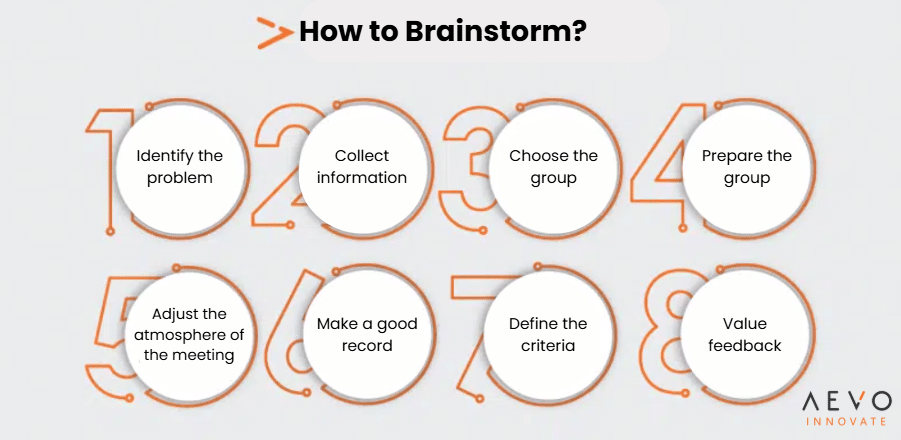
Brainstorming is common, but often ineffective. True CPS-based brainstorming requires:
- A problem statement that is simple, clear, and shared
- A diverse group of participants
- Zero criticism during idea generation
- A fixed time limit to maintain momentum
Once the divergent phase is complete, teams evaluate ideas based on relevance, feasibility, and expected impact.
When executed well, brainstorming becomes a powerful engine for operational improvement and innovation.
2. Design Thinking
Design Thinking prioritizes human-centered perspectives and is particularly effective for problems involving products, services, and experiences.
The core stages are:
| Stage | Description |
|---|---|
| Empathize | Observe real user behaviors and pain points. |
| Define | Synthesize insights to frame the challenge. |
| Ideate | Generate bold and diverse solutions. |
| Prototype | Build simplified versions quickly. |
| Test | Validate concepts with real users before scaling. |
Design Thinking reduces risk by validating desirability and usability early in the process.
3. SCAMPER
SCAMPER reframes ideas through seven guiding questions:
- Substitute something
- Combine elements
- Adapt in a new context
- Modify or magnify
- Put to another use
- Eliminate unnecessary parts
- Rearrange structure
SCAMPER is highly effective in product redesign, process improvement, and cost optimization.
4. Mind Mapping
Mind maps organize information visually, enabling teams to connect ideas that would otherwise appear unrelated.
This technique is useful for:
- Identifying root causes
- Structuring early-stage projects
- Discovering hidden opportunities
- Breaking cognitive patterns that limit creativity
Mind mapping works particularly well when teams face complexity or ambiguity.
5. Idea Management Programs
Idea management systems formalize creative problem solving across the organization. Platforms like AEVO Innovate allow companies to collect employee insights, evaluate ideas with structured criteria, prioritize high-impact contributions, and transform creativity into measurable results.
- Involves all employees, not only leadership
- Offers recognition and transparency
- Accelerates innovation pipelines
- Strengthens operational excellence
- Builds a continuous improvement culture
Programs thrive when employees feel ownership and see their ideas implemented.
How to Apply Creative Problem Solving in Your Company
Below is a practical step-by-step model used by organizations that operationalize CPS at scale:
1. Identify the Problem Clearly
A poorly defined challenge leads to fragmented efforts.
Ask:
- What exactly needs to be solved?
- What are the constraints?
- Who is impacted?
Avoid narrow problem statements, they can limit creativity prematurely.
2. Generate Ideas
Use CPS techniques that best fit your context.
Encourage participation across roles and departments. Diversity of thought is one of the strongest predictors of innovative outcomes.
3. Evaluate and Select Solutions
Not every idea is viable. Use criteria such as:
- Cost and required resources
- Implementation time
- Strategic alignment
- User value
- Expected ROI
Decision matrices and scoring systems help make selection more rigorous and objective.
4. Implement Through Pilots
Before scaling, test solutions in small, controlled environments.
Pilots:
- Reduce risk
- Expose hidden flaws
- Validate real impact
Adapt the solution based on what you learn.
5. Gather Feedback and Improve Continually
Innovation is iterative.
Collect data such as:
- Performance metrics
- Employee insights
- Customer feedback
Use these insights to refine the solution and keep it relevant over time.
Success Cases of Creative Problem Solving
3M
The famous “15% rule” empowered employees to explore personal projects. One experiment accidentally led to the creation of the Post-it, now one of the world’s most iconic products. CPS is embedded into 3M’s culture, and continues to drive breakthroughs across its 60,000+ product portfolio.
Scholle IPN
Scholle IPN sought operational improvements and found in AEVO Innovate a platform capable of scaling employee-driven creativity.
With an idea management committee and cross-functional collaboration, a frontline employee proposed a new Teflon replacement process, reducing changeover time from 15–20 minutes to just 30 seconds.
This single idea generated massive operational efficiency and validated the power of structured CPS.
LEGO
In the early 2000s, LEGO faced severe financial decline. Instead of retreating, the company turned to cognitive diversity and open innovation.
Through LEGO Ideas, fans began co-creating new sets. At the same time, strategic partnerships with Star Wars, Harry Potter, and Marvel reshaped LEGO’s value proposition, turning it into one of the most profitable toy companies in the world.
Need a refresh? Here is a video for you:
Conclusion
Creative problem solving is no longer optional; it is a critical capability for companies that want to thrive amid uncertainty, accelerate innovation, and stay competitive.
With the right processes, tools, and systems, organizations can transform everyday challenges into opportunities for growth.
AEVO Innovate empowers companies to scale creative problem solving through a complete innovation management platform, enabling structured programs, stronger governance, and measurable results.