We can define quality management as a coordinated set of practices, policies, and processes designed to ensure that products and services consistently meet, and ideally exceed, customer expectations. Far beyond simple standardization or end-of-line inspection, it represents a strategic approach that extends across the entire organization.
In today’s competitive environment, the pursuit of efficiency, reduced waste, and customer satisfaction has turned quality into a central pillar of business strategy. Whether in manufacturing, retail, or services, adopting strong quality practices helps organizations stay relevant and differentiate themselves. This approach also fosters continuous improvement, strengthens brand reputation, and makes it easier to obtain international certifications.
This article explains the foundations of quality management, the seven guiding principles established by ISO 9001, the main benefits for businesses, and how to put a Quality Management System (QMS) into practice while avoiding common pitfalls.
In this article
- What is quality management?
- Principles of quality management
- Benefits of quality management
- How to implement a Quality Management System (QMS)
- Challenges in quality management
- Conclusion
Listen to the summary of this blogpost here:
What Is Quality Management?
W. Edwards Deming, one of the field’s pioneers, famously defined quality as “meeting the needs of the customer, first and foremost.”
From a practical standpoint, quality management is a cross-functional, strategic approach that spans from setting objectives to monitoring performance indicators, engaging teams, and driving continuous process improvement. By placing quality at the center of management, organizations gain productivity, competitiveness, brand reputation, and customer loyalty.
As markets globalized and competition intensified, building a structured quality management system evolved into a strategic differentiator. Companies that invest in this discipline obtain certifications more easily and stand out for reliability and efficiency.
Quality as a discipline matured throughout the 20th century. While the Industrial Revolution standardized production at scale, the formalization of quality management emerged later through systematic methods, statistical control, and organization-wide frameworks that we still apply today.
Read some more:
- PDCA Cycle: The Ultimate Guide to Continuous Improvement
- Lean Production: Unlock 5 Powerful Principles and Tools for Efficiency
- Process Improvement: 5 Key Benefits and Essential Tools
Principles of Quality Management (ISO 9001:2015)
The ISO 9001:2015 International Standard outlines seven principles that guide the design of a robust quality management system. Treat these principles as strategic guardrails for organizational performance.
1) Customer Focus
Place the customer at the center of decisions. Understand needs and expectations to deliver solutions that create real value. Organizations with strong customer focus (customer-centricity) consistently meet requirements and often exceed them, strengthening loyalty and advocacy.
2) Leadership
Senior leadership must champion quality management. Executives set direction, align strategic and quality objectives, allocate resources, communicate clearly, and foster a culture of improvement and innovation. Without visible leadership, a QMS loses momentum.
3) Engagement of People
Quality is not the job of a single team. When people understand their role in processes and feel valued, engagement rises and results improve. Broad participation turns continuous improvement from a slogan into a daily habit.
4) Process Approach
A systems view reveals how activities interact and where constraints exist. Mapping, measuring, and managing processes, from inputs to final delivery, enables consistent control of quality management outcomes at every step.
5) Continuous Improvement
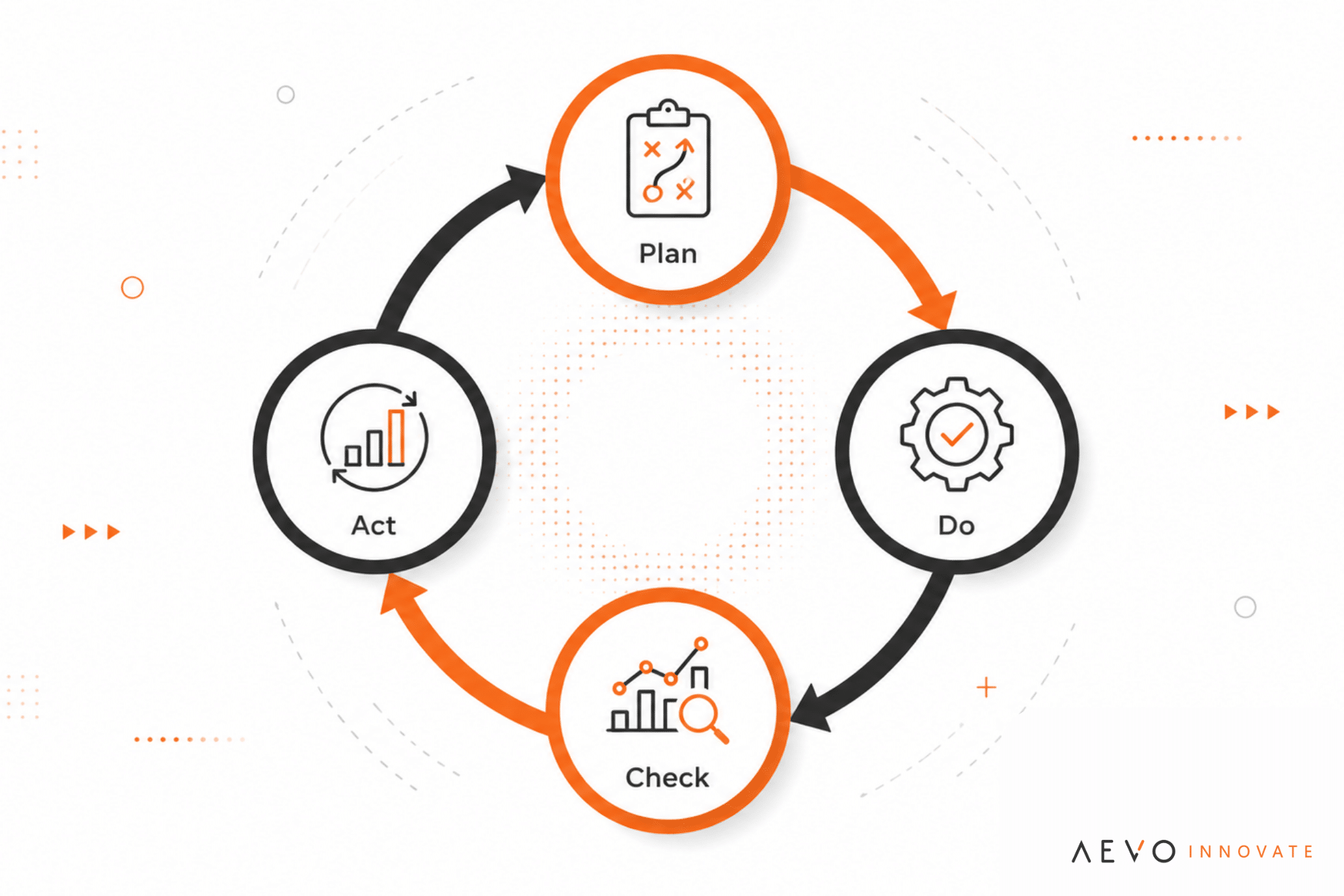
Successful organizations never stop improving. Methods such as PDCA (Plan-Do-Check-Act), Kaizen (gradual, ongoing enhancements), and platforms like AEVO Innovate – software for managing innovation programs – help identify opportunities and implement actions that lift productivity and operational efficiency. These tools build a culture of learning and collaboration, directly elevating the standard of quality management.
6) Evidence-Based Decision Making
Data only becomes insight when analyzed. By using indicators, statistical methods, and internal audits, companies reduce uncertainty and act with greater precision. Evidence-based quality management improves speed, consistency, and effectiveness.
7) Relationship Management
Quality extends beyond internal operations. Strong relationships with suppliers, partners, and stakeholders improve stability, trust, and collaboration – key to resolving issues and scaling solutions in a connected value chain.
Benefits of Quality Management
Still wondering whether quality management is worth the investment? The benefits speak for themselves:
Cost and rework reduction.
With defined processes and early detection, organizations prevent waste and avoid corrections down the line. Clear standards reduce variability and improve predictability.
Higher productivity and efficiency.
Standardization and ongoing monitoring streamline workflows and remove bottlenecks. Teams deliver more with less effort, increasing throughput without sacrificing quality.
Greater customer satisfaction.
When outcomes consistently meet or exceed expectations, customers perceive higher value and deepen trust. As a result, quality management strengthens relationships and boosts retention.
Brand strength and competitive advantage.
Reputation compounds. Companies recognized for quality differentiate themselves, win new customers more easily, and maintain pricing power. In crowded markets, a credible quality management system is a decisive edge.
How to Implement a Quality Management System (QMS)
A successful QMS is structured and participatory. Follow these steps:
1) Organizational Diagnosis
Start by understanding how the company truly operates. Map existing processes, identify strengths and weaknesses, gather baseline indicators, and listen to different areas. Tools such as SWOT analysis, process flowcharts, and stakeholder interviews reveal reality on the ground. This prevents disconnected initiatives and ensures quality management actions fit your context.
2) Quality Policy and Objectives
Based on the diagnosis, establish a clear quality policy aligned with company values and strategy. Communicate it to all levels and use it to define measurable objectives. These targets steer the team and must be reviewed regularly.
3) Process Design and Accountability
Define and standardize processes. Document how each activity works, clarifying steps, owners, deadlines, and acceptance criteria. BPM (Business Process Management) and value-stream mapping are helpful here. Establish indicators (KPIs) for each process to track performance over time. Clarify accountabilities to avoid gaps and enable autonomous, high-trust teams.
4) Training and Capability Building
You can’t sustain quality management without skilled people. Train teams so everyone understands new guidelines, tools, and best practices. Cover both technical and behavioral skills – leadership, communication, problem solving. Use corporate education, workshops, and digital platforms to keep content accessible and current.
5) Monitoring and Evaluation
Once processes are in place, monitor results with KPIs and internal audits. Common QMS indicators include rework rate, customer complaint index, average production time, and NPS (Net Promoter Score). Treat audits not as policing but as opportunities to fine-tune quality management and accelerate learning.
6) Certifications
With the system running and results emerging, many organizations pursue certifications that enhance credibility and competitiveness. ISO 9001 is the leading international standard for quality management systems, signaling global best practices and commitment to continuous improvement. Complementary methods such as Six Sigma help reduce variability and defects – especially valuable for operational excellence.

Challenges in Quality Management
Implementing a QMS is not free of obstacles:
- Resistance to change – Changing routines may trigger pushback; involve people early and communicate benefits clearly.
- Weak culture – Without leadership and engagement, the system loses traction; role models and ongoing training are crucial.
- Measurement difficulties – Without well-defined metrics, it’s hard to prove results; focus on clear, objective indicators.
Staying focused on problem solving, rather than blame, helps teams evolve processes, reinforce continuous improvement, and strengthen competitiveness.
Quality management can sometimes feel like a broad and abstract concept. To make it clearer, we’ve prepared a short video that summarizes the essentials:
Conclusion
The principles that sustain a QMS align with the use of AEVO Innovate, a platform that supports innovation programs, idea generation, and opportunity mapping. By enabling cycles of improvement and tracking indicators, it helps companies transform processes, products, and services into lasting competitive strengths.
If your goal is to embed improvement into daily operations and achieve tangible results, request a demo of AEVO Innovate and see how it can support your journey.