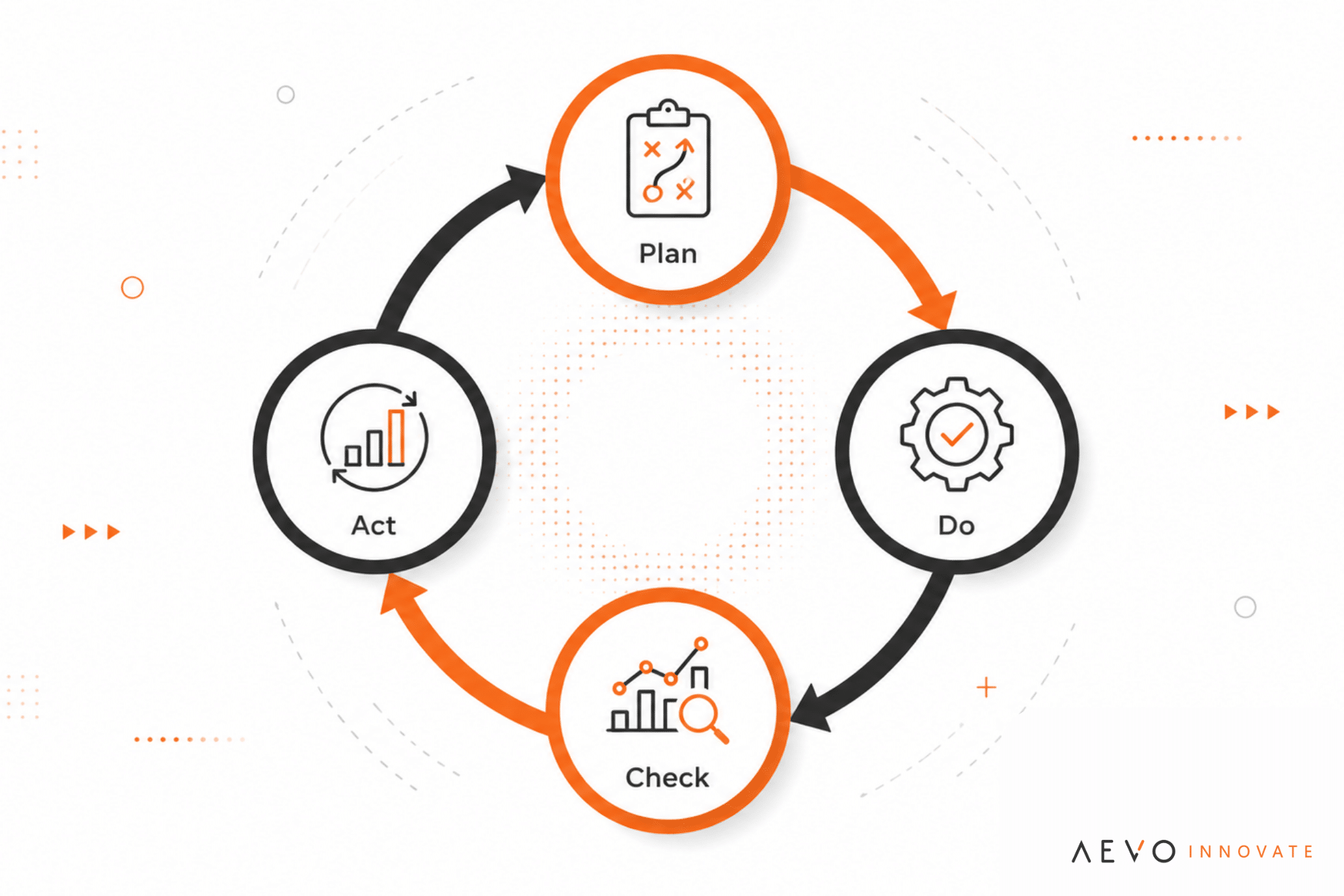
An innovation cycle provides organizations with a structured approach to transform ideas into measurable business results. Rather than treating innovation as a one-time initiative, it establishes a repeatable process for identifying opportunities, evaluating ideas, developing solutions, and implementing improvements that create value for customers and the business.
In today’s competitive environment, innovation has become a strategic capability rather than an occasional activity. Organizations that consistently outperform their competitors rarely rely on isolated brainstorming sessions, they build repeatable systems that allow innovation to happen continuously.
Research from McKinsey & Company highlights that companies with disciplined innovation practices are more likely to achieve above-average growth, while Boston Consulting Group reports that innovation remains one of the top strategic priorities for business leaders worldwide. However, many organizations still struggle to convert promising ideas into implemented initiatives that generate measurable value.
This is where the innovation cycle becomes essential.
Instead of relying on sporadic innovation efforts, companies can establish a structured framework that guides ideas from initial discovery through evaluation, experimentation, implementation, and continuous improvement.
Whether the objective is developing new products, improving internal processes, launching digital initiatives, or strengthening continuous improvement programs, a well-designed innovation cycle helps organizations innovate with greater consistency, speed, and strategic alignment.
In this guide, you’ll learn what an innovation cycle is, why it matters, how its 12 essential phases work, and how leading organizations use structured innovation processes to turn creativity into long-term business results.
Table of Contents
Listen to this blogpost’s summary here:
What Is innovation?
Before exploring the innovation cycle, it’s important to understand what innovation actually means.
Innovation is the process of creating and implementing new or significantly improved products, services, processes, business models, or ways of working that generate value for customers, employees, or the organization itself.
As Austrian economist Joseph Schumpeter argued, innovation is one of the primary drivers of economic growth. His concept of creative destruction explains how new ideas, technologies, and business models continuously replace outdated ones, allowing organizations to remain competitive and create new sources of value.
Innovation, however, extends far beyond breakthrough inventions.
For most organizations, innovation happens every day through incremental improvements that optimize operations, improve customer experiences, reduce costs, or create more efficient ways of working.
Examples include:
- Automating repetitive business processes
- Implementing Artificial Intelligence to accelerate decision-making
- Adopting Lean, Agile, or Continuous Improvement methodologies
- Developing new digital products and services
- Improving customer journeys
- Launching employee-driven innovation programs
Regardless of industry or company size, organizations that treat innovation as a structured capability are generally better positioned to adapt to changing markets and emerging opportunities.
Related reading: Idea Management: Scaling Innovation with Real Impact
What Is an Innovation Cycle?
An innovation cycle is a methodical approach to managing innovation. It breaks the process into stages, from identifying opportunities to implementing and improving solutions.
Schumpeter’s theory of innovation highlighted the role of entrepreneurship and disruption in economic evolution. The innovation cycle puts that theory into action by making innovation manageable and repeatable.
Typical stages in an innovation cycle include:
- Identifying opportunities through brainstorming, market research, or employee programs
- Evaluating and selecting ideas based on feasibility and potential impact
- Developing concepts and creating early prototypes
- Testing and validating those prototypes in real environments
- Scaling implementation and continuously improving the solution
This cycle ensures that innovation becomes a sustainable engine — not a one-time initiative.
What is an innovation cycle?
An innovation cycle is a structured framework that guides organizations from identifying opportunities to implementing solutions and continuously improving them.
Rather than treating innovation as a collection of isolated projects, the innovation cycle creates a repeatable process that helps companies consistently generate, evaluate, prioritize, develop, and scale ideas aligned with strategic business objectives.
The concept builds on the idea that innovation should be managed like any other core business capability, with defined processes, governance, performance indicators, and continuous learning.
Although organizations may customize their approach depending on their maturity and industry, most innovation cycles include five fundamental stages:
- Identifying opportunities through employee ideas, customer feedback, market research, or technology scouting
- Evaluating and prioritizing ideas based on strategic alignment, feasibility, and potential impact
- Developing concepts, prototypes, or pilot projects
- Testing and validating solutions before broader implementation
- Scaling successful initiatives while measuring business outcomes and continuously improving the process
Rather than representing a linear process, the innovation cycle is iterative.
Insights generated during implementation often lead to new opportunities, restarting the cycle and helping organizations build a culture of continuous innovation instead of relying on occasional initiatives.
This structured approach also enables organizations to integrate methodologies such as Design Thinking, Lean Startup, Stage-Gate, and Continuous Improvement, depending on the type of innovation and organizational context.
Why is the innovation cycle important?
In rapidly changing markets, organizations cannot rely solely on reacting to customer demands or technological disruption. They need a structured process that enables them to identify opportunities early, evaluate ideas objectively, and transform innovation into measurable business value.
An innovation cycle provides that structure.
Instead of depending on isolated brainstorming sessions or occasional innovation initiatives, organizations establish a repeatable system that continuously generates, evaluates, and implements new ideas aligned with strategic priorities.
Some of its main benefits include:
- Greater operational efficiency: continuous improvement initiatives help eliminate waste, optimize workflows, and improve productivity.
- Higher-quality products and services: structured innovation processes encourage experimentation, validation, and continuous learning before large-scale implementation.
- Lower operational costs: process improvements and automation reduce inefficiencies and unnecessary expenses.
- Stronger competitive positioning: organizations that innovate consistently are better prepared to respond to market changes and customer expectations.
- Improved employee engagement: giving employees structured opportunities to contribute ideas increases participation, ownership, and innovation culture.
- Greater adaptability: companies become more capable of responding to disruption while proactively exploring new growth opportunities.
Ultimately, the innovation cycle transforms innovation from an occasional activity into an organizational capability that can be measured, managed, and continuously improved.
How to implement an innovation cycle
Implementing a successful innovation cycle requires more than generating ideas. Organizations need clear objectives, engaged leadership, structured processes, the right technology, and continuous measurement to transform innovation into a repeatable business capability.
The following steps provide a practical roadmap for building an innovation cycle that supports sustainable growth and measurable business outcomes.
1. Identify organizational needs
The first step is understanding where innovation can create the greatest impact.
Rather than innovating for its own sake, organizations should identify strategic challenges, operational bottlenecks, customer pain points, and emerging market opportunities.
Frameworks such as Design Thinking, the Business Model Canvas, customer journey mapping, and data-driven opportunity assessments can help organizations prioritize the areas where innovation will generate the most value.
By starting with clearly defined business problems, companies create a stronger foundation for the rest of the innovation cycle.
2. Define clear objectives
Innovation initiatives should always support broader business goals.
Establish measurable objectives using frameworks such as SMART goals or OKRs (Objectives and Key Results) to ensure innovation efforts remain aligned with the organization’s strategy.
Typical objectives include:
- Reducing operational costs
- Improving customer satisfaction
- Accelerating product development
- Increasing employee participation
- Creating new revenue streams
- Supporting digital transformation
Clearly defined objectives also make it easier to evaluate the success of innovation programs over time.
3. Build an innovation culture
An innovation cycle is only effective when supported by a culture that encourages participation, experimentation, and continuous learning.
Leadership plays a critical role by creating an environment where employees feel empowered to contribute ideas and where experimentation is viewed as part of the learning process.
Organizations should encourage:
- Cross-functional collaboration
- Knowledge sharing
- Recognition of contributors
- Continuous learning
Many companies have successfully adopted initiatives that give employees dedicated time or structured opportunities to develop innovative ideas, demonstrating that innovation is not limited to specialized R&D teams.
4. Implement structured innovation processes
Without structure, ideas often fail to progress beyond brainstorming sessions.
Organizations should establish clear processes for collecting, evaluating, prioritizing, and implementing ideas.
This includes defining:
- Submission channels
- Evaluation criteria
- Governance models
- Approval workflows
- Project ownership
- Success metrics
Structured processes create consistency while allowing organizations to adapt their approach according to the complexity of each initiative.
5. Leverage technology to scale innovation
As innovation programs grow, spreadsheets, emails, and disconnected tools become increasingly difficult to manage.
Innovation Management Software helps organizations centralize idea collection, automate workflows, monitor performance, and improve collaboration across teams and locations.
Platforms such as AEVO Innovate support the entire innovation cycle by enabling organizations to:
- Capture ideas from employees and external partners
- Manage evaluation workflows
- Monitor innovation portfolios
- Track KPIs and ROI
- Apply AI-powered capabilities to accelerate decision-making
Technology enables organizations to scale innovation while maintaining governance and visibility across the entire process.
6. Invest in research and external collaboration
Innovation does not always originate internally.
Many organizations complement internal capabilities by collaborating with startups, universities, research institutions, technology providers, and other ecosystem partners.
Open Innovation initiatives help companies accelerate learning, access emerging technologies, and reduce the risks associated with developing every solution internally.
Organizations that combine internal idea management with external collaboration often create a more diverse and resilient innovation pipeline.
An innovation cycle should itself be continuously improved.
7. Measure, learn, and improve continuously
Organizations should regularly evaluate both the efficiency of their innovation process and the business impact generated by implemented initiatives.
Useful metrics include:
- Ideas submitted
- Evaluation cycle time
- Implementation rate
- Revenue generated
- Time to implementation
Monitoring these indicators helps organizations identify bottlenecks, improve governance, and ensure that innovation continues to support strategic business objectives.
Rather than viewing innovation as a series of isolated projects, organizations should treat it as a continuous management process that evolves through measurement, learning, and refinement.
The 12 Phases of a structured innovation cycle

While every organization develops its own approach to innovation, successful programs typically combine governance, leadership, employee engagement, technology, and performance measurement into a single management framework.
To help organizations build a more repeatable innovation process, AEVO Innovate has developed a Structured Innovation Cycle consisting of twelve complementary phases. Together, these phases help organizations move beyond isolated innovation initiatives and establish a scalable system that continuously generates, evaluates, implements, and measures ideas aligned with business strategy.
The framework is designed to support organizations at different stages of innovation maturity while providing enough flexibility to adapt to different industries, business models, and innovation goals.
| Pillar | Focus |
|---|---|
| 1. Engage People | Foster lasting buy-in and support. |
| 2. Train Teams | Prepare teams for effective execution. |
| 3. Support Leadership | Provide direction and presence from the top. |
| 4. Improve Processes | Continuously learn and adapt. |
| 5. Govern Ideas | Move ideas from committee to portfolio. |
| 6. Standardize Smartly | Maintain flexibility with clarity. |
| 7. Make Data Decisions | Use real-time data to guide actions. |
| 8. Integrate Systems | Unify platforms and KPIs. |
| 9. Ensure Visibility | Forecast impact and make progress visible. |
| 10. Align OKRs | Connect innovation to strategic goals. |
| 11. Prioritize ROI | Focus on ideas with measurable impact. |
| 12. Measure Constantly | Track progress for scalability. |
These stages help ensure that innovation is not just inspired, but also actionable, measurable, and repeatable.
Need a refresh? Here is a video about today’s reading.
How leading organizations apply the innovation cycle
The principles of the innovation cycle can be adapted to organizations of different sizes, industries, and levels of innovation maturity. While each company structures its process differently, successful programs share common characteristics: they encourage participation, establish clear governance, measure results, and continuously improve the innovation process.
The following examples illustrate how organizations have successfully implemented structured innovation cycles to generate measurable business value.
BIC: Scaling innovation across multiple sites
As a global manufacturer operating across multiple production facilities, BIC needed a consistent way to capture, evaluate, and implement employee ideas while maintaining governance across its operations.
Using AEVO Innovate, the company created a structured innovation process that enabled employees to submit ideas, collaborate on improvements, and monitor implementation.
The results include:
- More than 50,000 ideas submitted
- More than 30,000 ideas implemented
- More than 8,000 employees actively using the platform
- Operations connected across 11 manufacturing sites
- Employee participation rates reaching 90% in some locations
BIC demonstrates how a structured innovation cycle can transform continuous employee participation into a scalable system that supports operational excellence across multiple sites.
Energisa: Connecting a distributed workforce through innovation
With thousands of employees working across different locations, Energisa Group needed a more effective way to engage people in innovation than its traditional suggestion box.
After initially attempting to develop its own platform internally, the company adopted AEVO Innovate to centralize idea management and create a more scalable innovation process.
Employees gained easier access to the program through a mobile application, while administrators were able to configure workflows and manage the innovation program with greater autonomy.
The initiative generated significant results:
- 10,000+ registered users
- 2,000+ ideas submitted in 2023
- 250+ projects approved
- 16× innovation ROI achieved in 2023
The case illustrates how digitalizing the innovation cycle can increase participation while improving governance and business impact.
AIWA: Transforming employee ideas into measurable results
When AIWA, part of Grupo MK, decided to modernize its innovation program, employees were still submitting ideas through physical suggestion boxes.
By implementing AEVO Innovate, the company created a structured innovation cycle that made it easier to collect, evaluate, prioritize, and implement ideas across the organization.
The results include:
- 8,200+ ideas submitted
- 2,200+ ideas implemented
- R$285,000 in measurable financial returns generated during 2024
- More than R$2 million in projected gains identified for 2025
The case shows how combining employee engagement with structured workflows and technology enables organizations to transform ideas into measurable business outcomes.
Toyota: Continuous improvement as an innovation cycle
One of the most widely recognized examples of a structured innovation cycle is Toyota.
Rather than relying solely on breakthrough innovations, Toyota built a culture centered on continuous improvement (Kaizen), where employees are encouraged to identify opportunities, suggest improvements, test solutions, and standardize successful practices.
This continuous cycle of identifying problems, implementing improvements, measuring results, and learning from experience has become one of the foundations of Toyota’s operational excellence and has influenced organizations worldwide.
Although the methods differ across companies, the underlying principle remains the same: innovation becomes sustainable when supported by a repeatable process rather than isolated initiatives.
Final thoughts
An innovation cycle provides the structure organizations need to transform creativity into consistent business results.
Rather than depending on isolated brainstorming sessions or occasional innovation initiatives, companies can establish a repeatable process that guides ideas from opportunity identification through evaluation, implementation, and continuous improvement.
As the examples of BIC, Energisa, AIWA, and Toyota demonstrate, successful innovation is rarely the result of a single breakthrough. Instead, it is built through clear governance, engaged employees, effective leadership, and the ability to continuously learn and improve.
Technology also plays an increasingly important role in this journey. Innovation Management Software enables organizations to centralize idea collection, automate workflows, measure performance, and connect innovation initiatives directly to strategic business objectives.
Whether your goal is to strengthen Continuous Improvement, accelerate Idea Management, or build a more mature innovation ecosystem, implementing a structured innovation cycle can help your organization innovate with greater consistency, visibility, and measurable impact.
Ready to make innovation repeatable? Discover how AEVO Innovate helps organizations manage the entire innovation cycle, from idea generation to measurable business results. Request a demo and see the platform in action.