In today’s fast-paced business environment, organizations must constantly adapt to remain competitive. The PDCA Cycle (Plan-Do-Check-Act) is a proven methodology for driving continuous improvement, reducing waste, and optimizing processes.
Originally developed by Walter A. Shewhart and later popularized by W. Edwards Deming, this iterative framework helps businesses systematically solve problems, implement changes, and achieve sustainable growth.
By the end of this article, you’ll have a clear action plan to apply PDCA for measurable improvements in efficiency, quality, and performance.
Listen to this blogpost’s summary:
Table of Contents
What Is the PDCA Cycle?
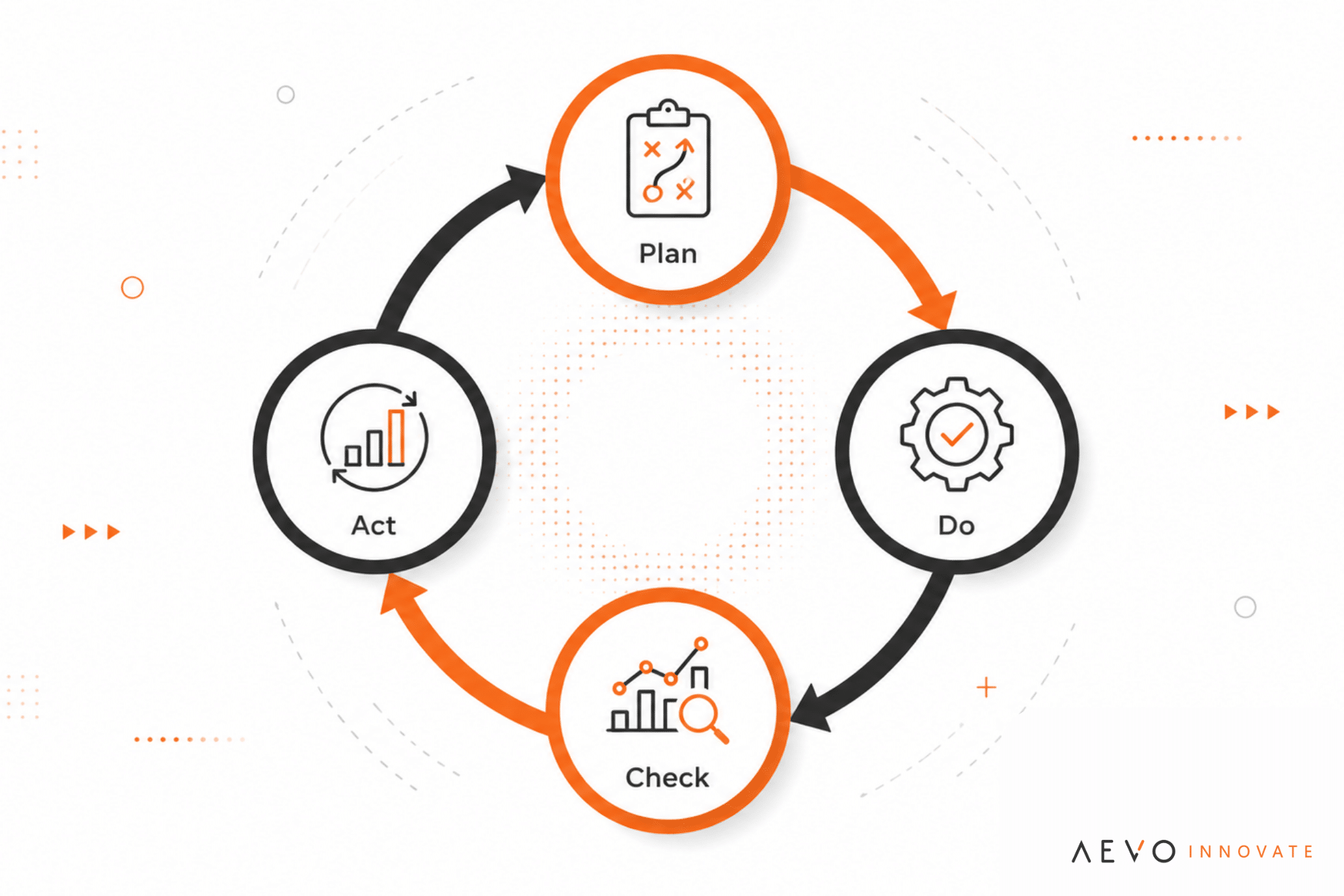
The PDCA Cycle (also called the Deming Cycle or Shewhart Cycle) is a four-stage iterative process for continuous improvement:
- Plan – Identify a problem, set objectives, and develop a strategy.
- Do – Implement the plan on a small scale (pilot test).
- Check – Analyze results and compare them against expectations.
- Act – Standardize successful changes or refine the approach.
This cycle never truly ends; it’s designed for ongoing refinement, making it ideal for Lean, Six Sigma, and Agile environments.
Why PDCA Cycle Matters
- Reduces inefficiencies by eliminating guesswork.
- Encourages data-driven decisions rather than assumptions.
- Improves adaptability in rapidly changing markets.
- Boosts employee engagement by involving teams in problem-solving.
Pro Tip: PDCA is widely used in manufacturing, healthcare, IT, and startups; any industry where process optimization is critical.
Read more: Idea Management: Scaling Innovation with Real Impact
The Origins of PDCA Cycle
1930s: Shewhart’s Statistical Control
- Walter Shewhart, a physicist at Bell Labs, introduced the concept of statistical process control (SPC).
- His book, Economic Control of Quality of Manufactured Product (1931), laid the foundation for quality management.
- Shewhart’s original model was PDSA (Plan-Do-Study-Act), focusing on learning from data.
1950s: Deming’s Influence
- W. Edwards Deming adapted Shewhart’s cycle into PDCA and introduced it to Japanese industries post-WWII.
- Japan’s manufacturing boom (e.g., Toyota’s Kaizen system) was heavily influenced by PDCA.
- By the 1980s, PDCA became a global standard for quality management.
Fun Fact: Deming later argued that “Study” (PDSA) was more valuable than “Check” (PDCA), leading to ongoing debate among quality experts.
The 4 Phases of PDCA Cycle

1. Plan – Define the Problem & Strategy
- Objective: Clearly identify what needs improvement.
- Key Steps:
- Gather data (e.g., customer complaints, production delays).
- Set SMART goals (Specific, Measurable, Achievable, Relevant, Time-bound).
- Develop a hypothesis (e.g., “Reducing setup time by 15% will improve output”).
Example: A hospital notices long patient wait times. The team sets a goal: “Reduce ER wait times by 20% in 3 months.”
2. Do – Execute the Plan on a Small Scale
- Objective: Test the solution without full commitment.
- Key Steps:
- Run a pilot test (e.g., in one department).
- Document every step for analysis.
- Train employees on new procedures.
Example: The hospital tests a new triage system in one ER shift to measure impact.
3. Check – Analyze Results
- Objective: Compare outcomes vs. expectations.
- Key Steps:
- Measure KPIs (e.g., wait times, patient satisfaction).
- Identify gaps & root causes (e.g., “Nurses lacked training on the new system”).
- Use data visualization (control charts, Pareto analysis).
Example: Data shows a 15% reduction in wait times, but some bottlenecks remain.
4. Act – Standardize or Adjust
- Objective: Implement successful changes or refine the approach.
- Key Steps:
- If successful → Roll out changes company-wide.
- If unsuccessful → Re-enter the cycle with adjustments.
- Update standard operating procedures (SOPs).
Example: The hospital trains all staff on the new triage system and schedules follow-up audits.
Expand your expertise: GenAI in Manufacturing: Rethinking Operational Excellence Beyond Automatio
PDCA vs. PDSA: Which Should You Use?
While PDCA is more widely known, PDSA (Plan-Do-Study-Act) offers a deeper analytical approach:
| Aspect | PDCA | PDSA |
| Focus | Verification | Learning & adaptation |
| Best For | Stable processes | Complex, evolving tasks |
| Key Difference | “Check” = Confirm results | “Study” = Dig deeper into why results occurred |
When to Use PDSA?
- In healthcare (where root-cause analysis is critical).
- For innovative projects with unknown variables.
How to Implement PDCA in Your Business
Step 1: Start Small
- Pick one process to improve (e.g., customer onboarding, inventory management).
Step 2: Train Your Team
- Ensure everyone understands PDCA principles.
- Use workshops or gamification to engage employees.
Step 3: Use the Right Tools
- Process Mapping (Lucidchart, Miro)
- Data Analysis (Excel, Minitab, Tableau)
- Project Management (AEVO Innovate)
Step 4: Monitor & Scale
- Track KPIs over time.
- Expand successful pilots to other departments.
Common PDCA Mistakes (And How to Avoid Them)
- Skipping the “Plan” phase: Leads to unclear goals.
- Testing on too large a scale: Wastes resources.
- Ignoring employee feedback: Reduces buy-in.
- Stopping after one cycle: PDCA is continuous!
Here is a video of today’s reading:
Conclusion: PDCA for Long-Term Success
The PDCA Cycle isn’t just a problem-solving tool – it’s a mindset shift toward continuous learning and improvement. Companies that embrace PDCA:
- Reduce costs by eliminating inefficiencies.
- Improve customer satisfaction through iterative refinements.
- Stay agile in competitive markets.
Ready to start? Begin with a small pilot project, measure results, and refine as you go.
Pro Tip: Combine PDCA with Lean Six Sigma for even greater efficiency gains!