Companies that want to remain relevant in today’s fast-moving markets need more than occasional innovation. They need a consistent evolution.
In this context, continuous improvement tools play a key role by offering effective methods to review processes, boost productivity, and correct failures before they become bigger problems.
Investing in this approach has become a strategic differentiator that can determine whether a business thrives or struggles in the long term.
In this article, you’ll learn what continuous improvement tools are, why they matter, and the most powerful tools to apply in practice.
In this article:
- Why continuous improvement matters
- What continuous improvement tools are
- Why organizations should use them
- The most important continuous improvement tools
- How to choose the right tool
- Tips for applying them effectively
- Key benefits
- Conclusion
Here is a summary audio of today’s reading:
Why Continuous Improvement Matters
Continuous improvement is directly linked to a company’s ability to stay competitive in a dynamic and unpredictable business environment.
Instead of viewing change as a threat, organizations that adopt continuous improvement embrace it as an opportunity for growth. This mindset strengthens adaptability and enables fast responses to new demands, crises, or opportunities.
It also broadens long-term strategic vision. By constantly analyzing, refining, and adjusting, companies act with greater clarity, align better with objectives, and prepare themselves to innovate consistently.
Leaders also gain more autonomy, becoming agents of transformation rather than just routine managers. In workplaces where improvement is valued, leadership can test new approaches, listen actively to teams, and implement changes more quickly.
On top of that, continuous improvement strengthens brand value. Companies committed to ongoing evolution gain credibility with partners, employees, and investors—unlocking opportunities for sustainable growth.
Read more:
- 8 Ways to Identify Opportunities for Continuous Improvement in Companies
- Idea Management: Scaling Innovation with Real Impact
What Are Continuous Improvement Tools?
In simple terms, continuous improvement tools are methodologies, techniques, or software that help companies identify, analyze, and solve problems systematically.
They are fundamental to process management and quality management, ensuring that operations remain optimized. Importantly, they are not exclusive to manufacturing—startups, hospitals, service firms, and tech teams can all benefit.
The key lies in choosing tools that fit the company’s unique context. When applied correctly, they foster collaboration, improve results, and create a foundation for sustained growth.
Why Use Continuous Improvement Tools?
Adopting continuous improvement tools is no longer optional—it’s a necessity.
These tools allow organizations to:
- Map processes and identify inefficiencies
- Reduce waste and costs
- Enhance quality of products and services
- Promote a culture of collaboration and ownership
Well-prepared teams become more proactive, creative, and engaged. Innovation becomes part of the routine, enabling businesses to anticipate trends and adapt quickly.
Beyond solving issues, these tools also strengthen what already works and create fertile ground for new ideas. Instead of relying on big transformations, companies evolve through short, consistent cycles.

The Main Continuous Improvement Tools
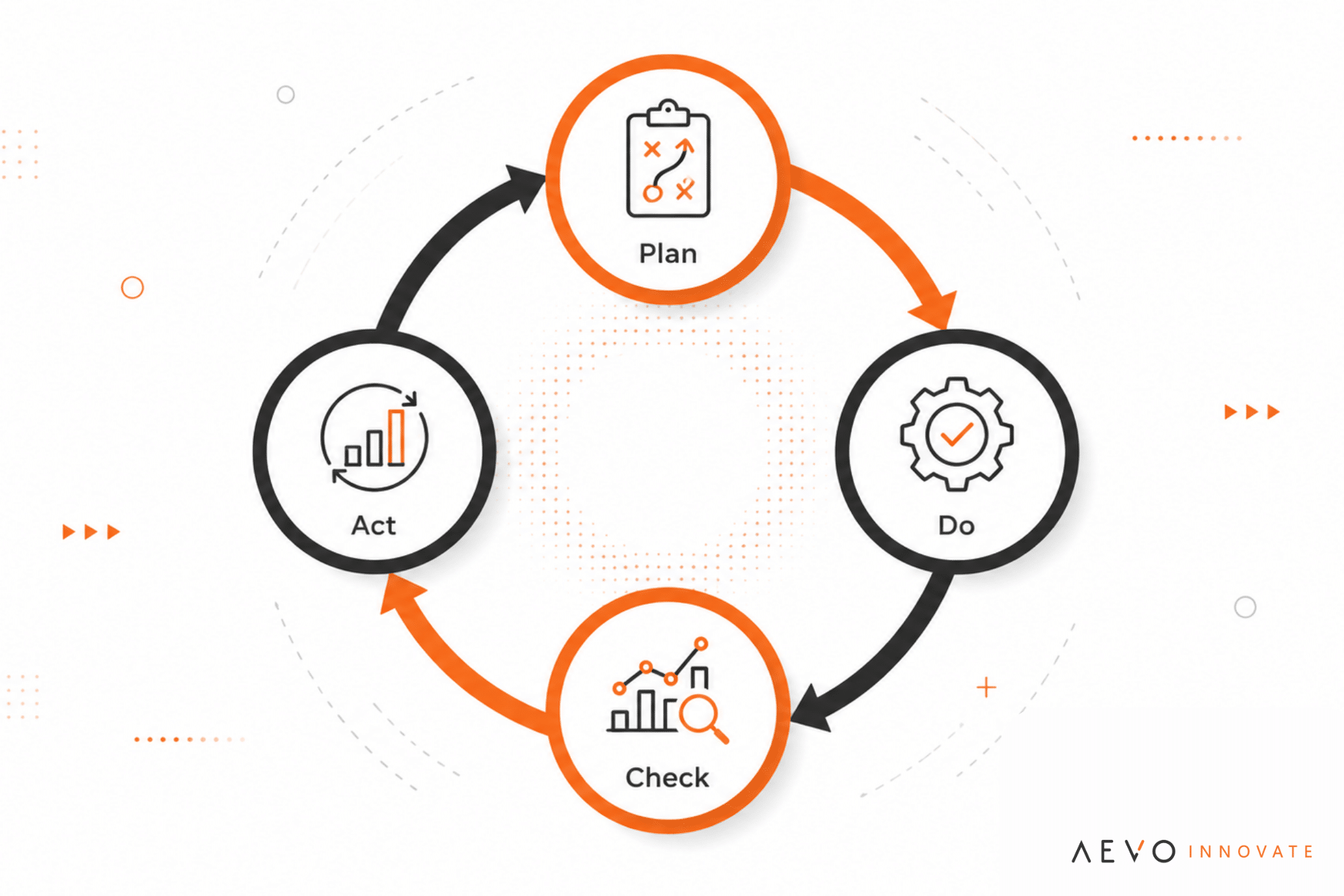
1. PDCA Cycle (Plan, Do, Check, Act)
First proposed by Walter Shewhart in the 1930s and popularized by W. Edwards Deming after WWII, the PDCA Cycle is a classic tool for iterative problem-solving.
- Plan: Identify a problem and create an action plan.
- Do: Implement the solution on a small scale.
- Check: Measure and compare results against expectations.
- Act: Standardize successful solutions or adjust and restart the cycle.
2. Ishikawa Diagram (Fishbone)
Developed in the 1940s by Kaoru Ishikawa, this diagram helps identify root causes of problems.
It often uses the 6Ms framework: Machines, Materials, Manpower, Environment, Measurements, and Methods—guiding teams toward effective solutions.
3. AEVO Innovate
AEVO Innovate is a cloud-based software designed to manage innovation and continuous improvement initiatives.
It enables organizations to map processes, automate workflows, and monitor metrics in real time, creating an integrated and scalable environment for continuous improvement.
4. 5S Methodology
Originating in post-war Japan, 5S is about workplace organization and discipline:
- Seiri: Sort and eliminate what isn’t needed
- Seiton: Set in order and define a place for everything
- Seiso: Shine and keep the workplace clean
- Seiketsu: Standardize to sustain the first three steps
- Shitsuke: Sustain discipline and make it a habit
5. Kaizen
Kaizen is a philosophy of gradual, continuous improvement through small, constant changes.
It encourages everyone—from leadership to frontline employees—to contribute suggestions for optimization. It often works hand in hand with 5S.
6. Brainstorming
A simple but powerful group technique for generating ideas. All ideas are welcomed initially, and only afterward are they filtered and evaluated for feasibility.
7. Pareto Diagram
Based on Vilfredo Pareto’s 80/20 principle and refined by Joseph Juran, this tool highlights the “vital few” causes responsible for most effects.
By visualizing problems in order of frequency or impact, teams can focus on solving issues with the highest return.
8. Process Flowcharts
Visual diagrams that map every step of a process, using standardized symbols for actions, decisions, and flows.
They make processes easier to understand, identify bottlenecks, and support training and onboarding of new employees.
9. Lean and Six Sigma
Lean focuses on eliminating waste, while Six Sigma reduces variability and defects.
Together, they streamline operations, increase productivity, and improve quality. These methodologies are widely used in industries like manufacturing, healthcare, logistics, and finance.
How to Choose the Right Tool
There’s no one-size-fits-all solution. The best tool depends on the organization’s context, type of process, resources, and team expertise.
- Data-heavy processes: Six Sigma may be more effective.
- Wasteful operations: Lean or flowcharts can help.
- Complex problems: Ishikawa or PDCA provide structure.
It’s also possible to combine different tools for greater impact. What matters is aligning the tool with organizational needs and capabilities.
Tips for Applying Tools Effectively
To ensure results:
- Involve the whole team—collaboration makes improvement sustainable.
- Invest in training—equip employees with knowledge and confidence to apply tools correctly.
- Monitor progress—use metrics and KPIs to measure effectiveness and refine actions.
With continuous evaluation, organizations can reinforce learning and demonstrate the tangible value of improvement.
Benefits of Continuous Improvement Tools
By adopting continuous improvement tools, companies achieve:
- Greater agility and efficiency
- Reduced rework and costs
- Higher product and service quality
- Stronger competitiveness
- Sustainable growth driven by innovation and excellence
Ultimately, continuous improvement is more than an operational tactic; it’s a strategic approach that positions businesses for long-term success.
Need a refresh? Here is a video for you:
Conclusion
Each of the continuous improvement tools discussed has unique benefits and applications. Used together, they form a powerful toolkit for solving problems, driving innovation, and building resilience.
Organizations don’t need to limit themselves to one tool. Combining approaches creates synergy and maximizes impact.