The quest for the next disruptive idea often leads companies to overlook the most powerful engine of growth: the small, daily refinements made by their own teams.
In established markets across North America and Europe, the difference between a market leader and a struggling firm isn’t usually one massive invention, but the cumulative effect of a thousand tiny improvements.
A Continuous Improvement Culture isn’t just a corporate buzzword or a box to tick during an annual audit. It is a fundamental shift in how every individual in your organization views their workday. Instead of merely completing tasks, employees begin to look for the friction in their processes and feel empowered to fix it.
Table of Contents
Here is a summary audio of today’s reading:
What does a Culture of Improvement actually look like?
While many associate continuous improvement with the Japanese philosophy of Kaizen, it has been successfully localized into Western business models through frameworks like Lean, Six Sigma, and Agile. However, a true culture goes beyond these technical tools.
It represents a move away from the hero model of management, where one leader solves all problems, toward a distributed intelligence model. In this environment, identifying a bottleneck is seen as a contribution, not a complaint. It’s the transition from a mindset of “fixing what’s broken” to “refining what’s already working.”
Why efficiency is the ultimate competitive moat
In high-cost labor markets like the US or the EU, and within the increasingly automated landscape of Industry 4.0, operational waste is more than just an annoyance, it’s a threat to margins. Organizations that prioritize a culture of constant evolution see three primary benefits:
- Compound Efficiency: saving five minutes on a daily task might seem trivial. But across a team of 100, that’s over 2,000 hours of reclaimed productivity per year. This results in quantifiable hard savings that directly strengthen the P&L.
- Talent Retention: in the current “war for talent,” professionals want to work in environments where their expertise is respected. Giving employees a voice in how their work is done is a powerful motivator.
- Resilience: a company that is constantly tweaking its processes is far more capable of pivoting when market conditions change or new regulations (like the latest ESG mandates) are introduced.
The 4 pillars of a sustainable improvement mindset
1. Leadership as a support system
The most common point of failure is “improvement by decree.” If leadership only talks about efficiency but rewards the status quo, the culture will never take root. Leaders must act as coaches, asking “What is preventing you from doing your best work today?” rather than simply demanding higher output.
2. Standardized frameworks (PDCA)
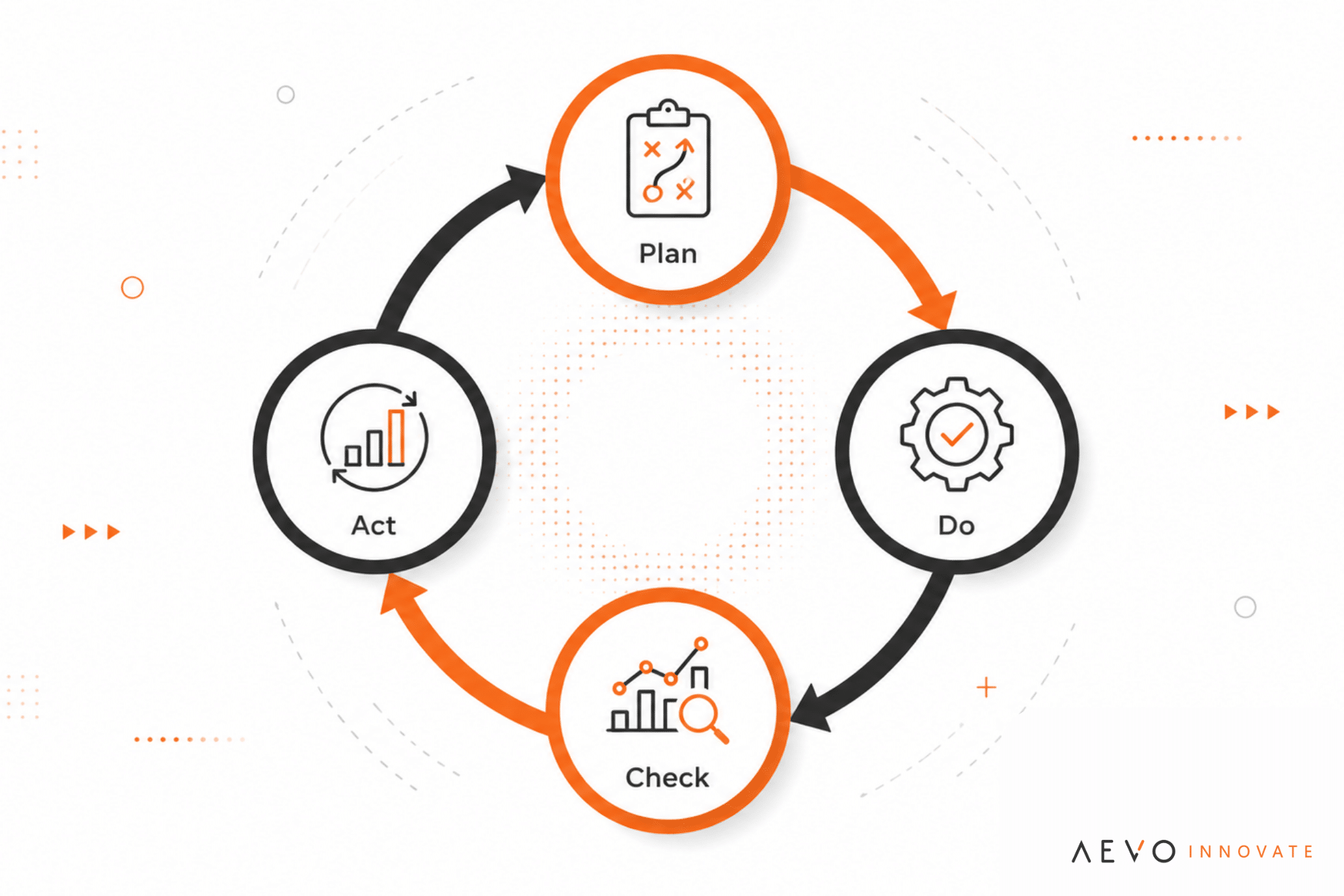
Without a shared methodology, improvement efforts become chaotic and uncoordinated. The Plan-Do-Check-Act (PDCA) cycle remains the gold standard for a reason. It provides a simple, repeatable logic for testing new ideas on a small scale before rolling them out globally, ensuring that improvement doesn’t accidentally lead to more complexity.
3. Psychological safety and the “right to fail”
True innovation requires a high degree of psychological safety. If an employee fears that a suggestion might fail or that pointing out an error will lead to blame, they will stay silent. A healthy culture celebrates the learning derived from an unsuccessful experiment as much as the success of a lucky one.
4. Digital management and visibility
The clarity of data and accessibility are primary indicators of system quality. The same applies to your internal innovation. Using a centralized platform like AEVO Innovate Innovation Management Software is critical for moving beyond messy spreadsheets.
AEVO Innovate provides a transparent environment where improvements are tracked in real-time. By leveraging AI-powered clustering and automated triaging, the platform ensures that every contribution is acknowledged, and successful changes can be scaled across different departments or global offices instantly. It turns continuous improvement from a vague concept into a measurable, data-driven strategy.
Overcoming the “status quo” bias
The greatest obstacle to progress is the comfort of the familiar. Humans are wired to resist change, especially when they feel that their existing expertise is being challenged.
To overcome this, successful organizations tie improvement goals to the company’s core mission. When the team understands why a process is changing, whether it’s to improve customer satisfaction or achieve zero-waste targets, they are much more likely to embrace the new way of working.
Conclusion
A Continuous Improvement Culture requires a long-term commitment from the top and a high degree of trust from the bottom. However, as the 2026 market becomes increasingly dominated by AI-driven speed and automation, the companies that succeed will be those that have mastered the art of human-led refinement.
By combining a solid cultural foundation with the right technology, such as AEVO Innovate, your organization can ensure that it isn’t just working harder, but working smarter every single day. Want’s more information about our technology? Schedule a meeting with our experts today.
Need a refresh? Here is a video for you:
Frequently Asked Questions (FAQ)
How do we start building a continous improvement culture if our team is currently resistant to change?
Start small. Choose one high-friction, low-risk process and invite the team to suggest improvements. Implementing a quick win proves to the staff that their voices matter and that change can actually make their lives easier, rather than just adding more work.
Can we maintain a culture of improvement with a fully remote or hybrid workforce?
Absolutely. In fact, it is often more necessary in remote settings where invisible inefficiencies can thrive. Using a digital platform like AEVO Innovate becomes even more essential here, as it provides a virtual hub where team members from different time zones can collaborate on and vote for new ideas.
What is the difference between Innovation and Continuous Improvement?
Innovation often refers to a significant leap: a new product or a total business model shift. Continuous Improvement is the steady, incremental refinement of existing processes aimed at reducing waste and optimizing current assets. While they are different, they are symbiotic. A strong culture of improvement often identifies the gaps that lead to the next big innovation.