How many companies have seemed unbeatable, only to disappear from the market over time?
There are plenty of stories like this. Organizations that led their industries, but relied too heavily on old formulas and failed to react as the world around them changed faster than they could.
Strategies that worked in the past are unlikely to guarantee business relevance success in the future. The market changes at a relentless pace. Customers do not behave as they did before, technologies emerge rapidly, and competition is always ready to fill gaps.
McKinsey’s research on transformations shows that less than one-third of transformations are fully successful (i.e., improving performance and sustaining it).
Given this scenario, the inevitable question arises: how can an organization remain relevant over time?
In this article:
- Doing the Same: The Risk of Losing Business Relevance
- Occasional Improvement: The Illusion of Progress
- Continuous Improvement: The Foundation of Business Relevance
- Innovation: The Unstable Engine of Leaps and Risks
- The Winning Formula: Innovation + Continuous Improvement
- How to Assess Your Business Relevance
- Food for Thought
Listen to this blogpost’s summary:
The chart below offers a lens through which to answer this question:
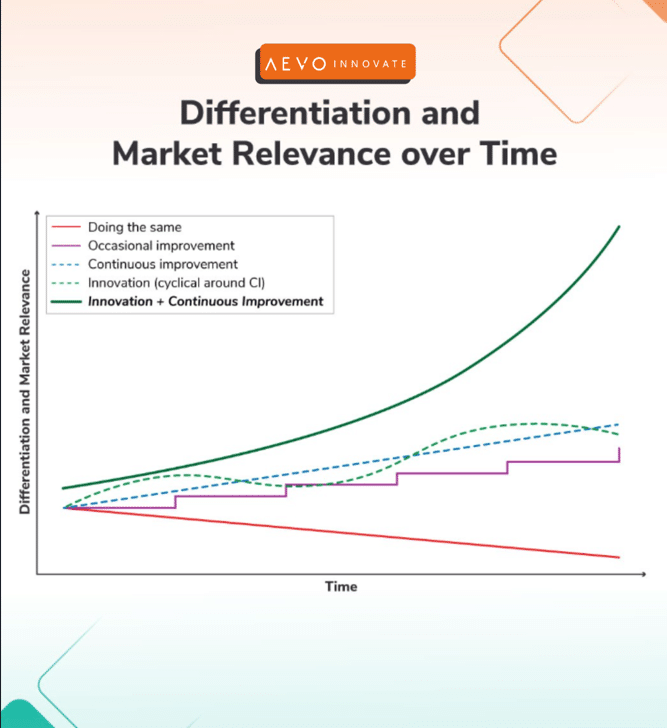
Each strategic choice charts a distinct path, and some options, however safe they may seem, lead to an inevitable decline in competitiveness.
Doing the Same: The Risk of Losing Business Relevance
The first path is the red line on the graph, descending, representing companies that neither change nor adapt.
At first glance, continuing to do what has always worked seems reasonable. After all, why change something that has been successful? “Don’t change a winning team,” they say.
But the problem is: the world is always changing. While a company repeats old formulas, competitors test new approaches, customers adjust their expectations, and technologies render practices that were once differentiators obsolete.
The result is predictable: the curve descends continuously. There is no neutrality. Those who do not (re)position themselves and evolve lose ground.
Inaction is not neutral; it erodes business relevance day by day. Kodak, Nokia, and Blockbuster all fell not from lack of resources, but from the illusion of stability. Maintaining business relevance requires constant movement, a willingness to question habits and challenge what once felt safe.
Occasional Improvement: The Illusion of Progress
The purple line, in steps, illustrates a common trap: companies that change only when forced to. They make occasional adjustments, almost always reactively in times of crisis.
These movements even generate momentary leaps in performance, but soon return to the previous level. The organization gains momentum for a few months, but does not create consistency. This attitude is dangerous because it feeds the feeling of progress without actually changing course.
It’s like trying to swim against the current only when you realize you’re being swept away: the effort is immense, the anxiety to get out of a dangerous situation prevents you from seeing other ways out, and progress is minimal.
Continuous Improvement: The Foundation of Business Relevance
This is the blue, upward line that clearly conveys the idea of constant evolution.
Organizations that adopt structured practices (such as Lean, Kaizen, idea management programs, or Customer Experience) are able to achieve solid, stable, and predictable growth. It is not about big leaps, but consistency.
This discipline prevents the company from relying on miracle solutions or isolated movements. It creates a cultural foundation, mature processes, and metrics that sustain performance over time.
Continuous improvement alone already puts the company above average, but it is still not enough to generate exponential differentiation.
Innovation: The Unstable Engine of Leaps and Risks
Here, we are talking about the light green line, which oscillates around the blue line of continuous improvement.
Innovation generates significant advances. Some projects transform markets, open new revenue streams, and reposition the company at higher levels. In contrast, others consume time, energy, and resources without delivering the expected results. This variability is part of the game.
It is often a trade-off that pays off. The balance is positive, but innovation is, by nature, an unstable practice.
The challenge is that when innovation is conducted without structure, the risk increases. Organizations end up accumulating scattered initiatives with little strategic connection, poor governance, and results that are difficult to measure. This creates the feeling that innovation is an “accessory,” something optional, subject to the enthusiasm of a few internal champions.
The Winning Formula: Innovation + Continuous Improvement
The last line is called “Innovation + Continuous Improvement.” It is the dark green, exponential line that shows the result of combining discipline and boldness.
This strategy creates a virtuous cycle:
- Continuous improvement ensures stability, constant learning, and resilience.
- Innovation broadens horizons, opens new markets, solves problems, and drives new sources of revenue.
When these two forces work together, growth ceases to be linear or irregular and becomes exponential and sustainable. This is the only way to keep the organization ahead of the average, without relying on luck or improvised reactions.

How to Assess Your Business Relevance
Seeing these curves is not just a conceptual exercise. It is an invitation to self-criticism.
Every leader, at some point, needs to ask themselves: “Which of these paths is my company really on?”
Some signs help to diagnose this:
- Doing the Same: decisions always justified by history; resistance to changing processes; frequent customer complaints about the lack of certain features, possibilities, and/or services.
- Occasional Improvement: projects launched only in response to crises; improvements that disappear when the pressure is off; lack of continuity.
- Continuous Improvement: structured rituals and practices for continuous improvement; monitored metrics; culture focused on incremental learning.
- Innovation: strong focus on new products and services; unpredictable results, with great successes, but also with notable setbacks;
- Innovation + Continuous Improvement: balance between operational efficiency and boldness; teams engaged in daily evolution, while the company explores new growth opportunities.
Some important lessons learned:
- Stagnation is not neutral. Doing the same thing does not keep the company in the same place, but rather pushes it down;
- One-off improvements are not enough. They may offer temporary relief, but they do not create a competitive advantage;
- Continuous improvement is the foundation. It ensures predictability and competitiveness in the long term;
- Isolated innovation will always be unstable ground. It can generate big leaps, but it can also expose you to unnecessary risks, especially when there are no structured processes, measurable indicators, or a well-aligned strategy;
- The combination is unbeatable. Innovation supported by continuous improvement is the formula that ensures exponential growth and lasting relevance.
If this article sparked reflection, the video below brings the story full circle.
Food for Thought
When you look at this graph, which curve does your organization fit into today? And, more importantly, which line are you building for your business relevance in the coming years?
The future does not belong to those who merely react. The future belongs to those who build consistency and, on that solid foundation, dare to innovate.
This is the difference between companies that merely survive and companies that become benchmarks.