Process improvement is one of the most sought-after and invested practices by companies around the world.
Also known as BPI (Business Process Improvement), achieving internal process improvement requires a set of actions that help corporations meet their objectives more efficiently.
In other words, investing in process improvement is taking a 360° view of the company since it impacts employees, business models, and even the company’s market perception.
In this article, we’ll dive deeper into process improvement and explain why this topic deserves your attention. Keep reading.
In this article:
- What is process improvement?
- Challenges in implementation
- Main benefits
- Methodologies for process improvement
- Steps of process improvement
- Tools that assist in process improvement
- Process improvement application example
- Conclusion
Here is a summary audio of today’s reading:
What Is Process Improvement?
Process improvement (or BPI) refers to a set of practices and initiatives aimed at analyzing current processes and enhancing them in practice. The goal is to promote more operational efficiency, reduce costs, increase productivity, and improve employee and customer satisfaction.
BPI seeks to map and assess the entire scope of the company, filter out negative impacts, and reformulate these areas to achieve the desired improvements.
The ultimate result is increasing value delivery, whether to the customer or the company itself, as we will explore later. In short, the practice generates positive results for the business through continuous improvement.
In increasingly competitive market scenarios, companies need to invest in solutions that enhance their level of efficiency across various aspects. And this is where process improvement comes into focus.
This is a strategy that involves different methodologies, aiming to optimize each area of the business.
Beyond the obvious benefits of optimizing internal processes, BPI is crucial for a company to maintain and increase its potential.
Just look at the ongoing advancements in artificial intelligence and how businesses in all sectors are being driven to adapt their processes to stay relevant.
Challenges in Implementation
Organizations that have managed to adapt, or those that emerged in modern contexts, find it easier to recognize the importance of process improvement. However, this doesn’t mean that implementation is easy, especially during times of forced restructuring.
One of the main challenges is resistance; not only from operational staff but also from management. Change requires movement, and not everyone is open to giving up what, in theory, works for them in favor of something unknown and proposed by others.
This resistance is even more impactful if there is no solid organizational culture, especially one focused on continuous improvement. In such cases, it requires more effort to communicate the need for change, highlight its practical effects, and invest in phased implementation.
Finally, the most impactful factor in the implementation of improvements is the lack of data.
Why change if things are already working as they are? What proves that the proposed improvement will actually make the processes better? These are questions primarily asked by C-level executives to validate the new model.
Read more:
- 8 Ways to Identify Opportunities for Continuous Improvement in Companies
- Kaizen Methodology: The 5 Principles for Continuous Improvement
- Innovation Culture: What It Is, Pillars, and 4 Essential Behaviors to Promote
Main Benefits of Process Improvement
We cannot talk about process improvement without discussing its benefits, as they are directly linked. A company that invests in BPI implementation is likely to experience positive impacts across the entire production chain.
Increased Productivity
Operational efficiency makes teams more organized, integrated, and engaged, with solid structures and smooth processes.
By improving processes, productivity across the board benefits, as the company can focus on what truly drives qualitative and quantitative results.
Cost and Rework Reduction
Immediately after applying process improvement, companies see reductions in costs and rework steps.
This happens because BPI implementation aims to eliminate everything that negatively impacts management and operations, improving the factors that contribute to proper functioning.
Improved Product and Service Quality
With less resource waste, companies can invest in new quality control techniques, automated systems, and even higher-quality raw materials. The result is an increase in perceived value in the delivery of products and services.
Greater Customer and Employee Satisfaction
Better products and services lead to more satisfied customers. Innovation platforms can be used to develop ideas and solutions that address customer pain points and desires.
Additionally, with such a system in place, it’s possible to assess employee engagement regarding their commitment to continuous improvement and innovation within the business and understand which areas still need optimization or can be enhanced.
Organizational Agility and Flexibility
Process management allows for a holistic view of the company, meaning quicker responses in crisis situations and less impact on production flows. Moreover, more organized processes tend to offer greater flexibility, especially in times of business growth.
Methodologies for Process Improvement
Process improvement sets objectives based on benefits, and its implementation can be carried out through various methodologies. Here are the main methodologies, their concepts, and key characteristics for application within companies:
- PDCA Cycle
A methodology that helps establish an initial organization but focuses on continuous improvement.
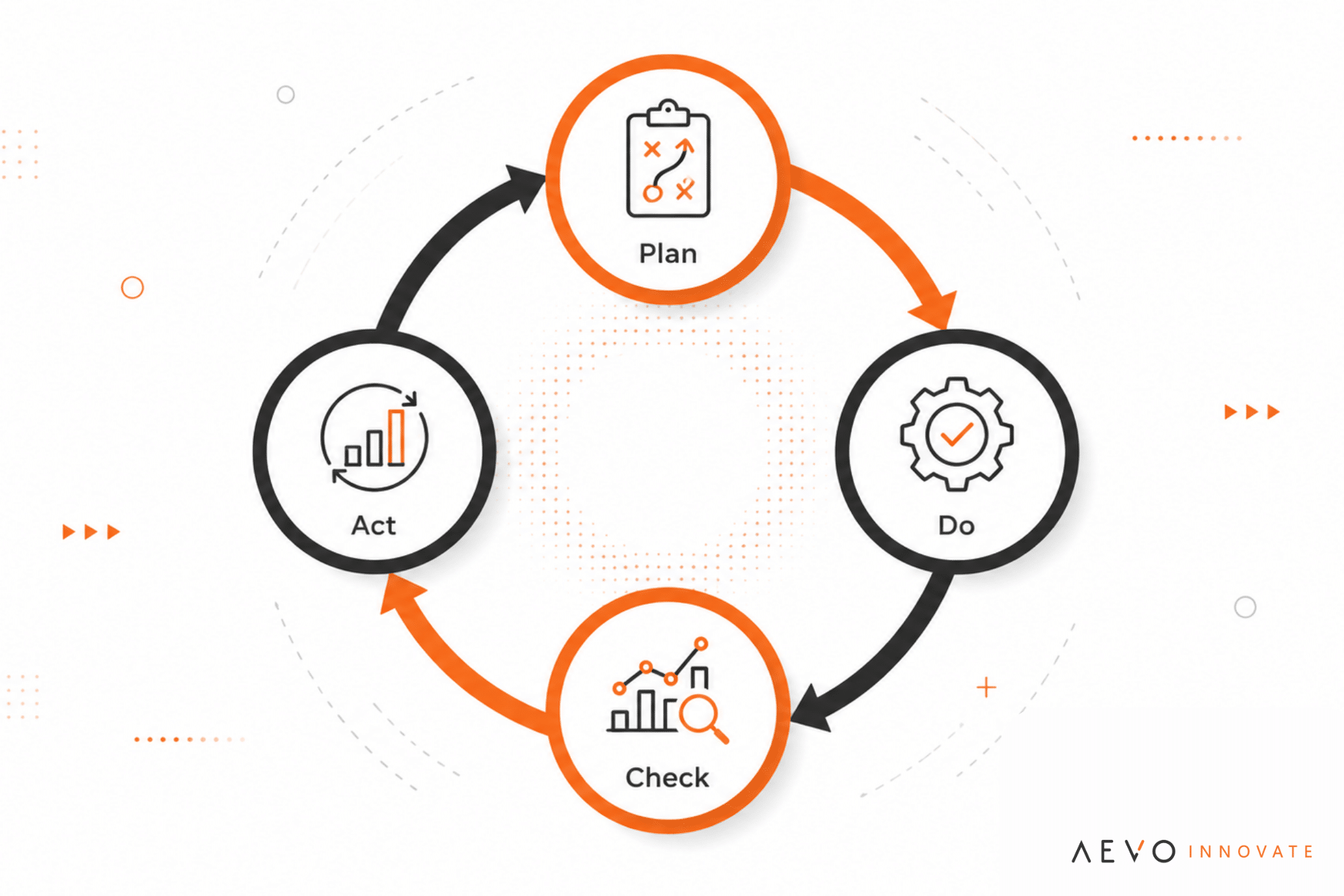
The PDCA stages are: Plan, Do, Check, and Act, enabling companies to continuously review their internal processes, reformulating their structure based on their needs and even sudden market changes.
- Six Sigma
Six Sigma is a methodology more focused on improving what has already been done in process improvement.
In the industry, its application reduces process variation, prioritizing stages that result in higher product quality.
- Lean Manufacturing
Lean Manufacturing is widely used in situations that require cost reduction, waste elimination, increased productivity, and focus on final product quality. Its origins are linked to the Toyota Production System, making it a reference across various industrial sectors.
- Business Process Management (BPM)
Although intertwined, BPI and BPM work at different moments.
The BPM model looks at the business as a whole, helping to map processes that will be improved within BPI implementation.
This allows the company to perform integrated management and apply continuous process improvement in line with business objectives.
Steps in Process Improvement
Regardless of the chosen methodology, process improvement happens in steps, collecting data and other insights that will be used to create the new model.
Some of these steps can be more complex than others, particularly in relation to company size and the impact of current processes on production flows.
1. Mapping and Diagnosis of Current Processes
It all starts with a solid mapping. This step involves gathering all flowcharts and methods that offer visibility on how current processes are built and executed in practice. With this comprehensive view, a deeper analysis of bottlenecks can begin.
2. Identifying Failures and Bottlenecks
After analyzing processes from a 360° perspective, teams can more precisely identify where failures occur.
Categorizing these failures as minor, medium, or critical and associating them with the impact on final products or services is essential.
It’s crucial to combine this step with data collection, such as raw material waste, unused tools, and unproductive labor allocation, which can help create reports justifying the need for process improvement.
3. Proposing Improvements
With the analysis in hand, it’s time to create reports and materials contrasting the current process with the proposed improvement.
Highlight the expected impacts, based on the numbers collected earlier. It’s also important to include a communication plan for operational areas, as this change will directly impact such sectors.
4. Implementing Changes
Once the action plan is approved, it’s time for implementation. A structured schedule by area, clearly identifying each responsible party and deadlines, ensures better control over the project’s execution while redistributing steps based on unexpected factors like time, budget, or external factors.
5. Monitoring and Evaluation
After the improvement project is implemented, the next step is continuous improvement, which is about applying one of the earlier methodologies. This ensures that the company can stay up-to-date on organic changes in management, business models, and external contexts, as well as maintaining alignment among teams, managers, and the market.
At this stage, KPI definitions, monitoring, and performance reports come into play. An improvement that has generated good results can be replicated, while one that hasn’t can be revised, but always based on data.
Tools that Assist in Process Improvement
Several tools are available to assist in the stages of process improvement. Some are specific to technological innovations, while others are versatile enough for accounting firms or even industries.
- Ishikawa Diagram: A tool that helps identify points in the mapping phase that are impacting the production chain.
- GUT Matrix: Helps prioritize each mapped process based on severity, urgency, and trends, linking its application to short-, medium-, and long-term benefits.
- Process Management Software: Allows the creation of boards for each team, remote management, real-time capacity visualization, and integration with other digital tools.
Process Improvement Application Example
MRV & Co, operating in the real estate sector for years, recognized that managing manual processes and having underappreciated teams were impacting their results.
By implementing an innovation-focused tool for process improvement (AEVO Innovate), the company managed to automate workflows within a single platform, transforming process management.
More engaged teams, centralized innovation flows, and the practicality of one tool managing it all generated approximately R$30 million in savings for the company and engaged over 4,000 employees in the program.
Need a refresh? Here is a video for you:
Conclusion
Process improvement is a fundamental pillar of any innovative company focused on sustainable growth.
If your company aims to invest in structured process improvement with methodology and essential resources for significant results, AEVO Innovate is here to support you.
AEVO Innovate is a complete innovation management platform, equipped with cutting-edge technology and AI-driven resources, and has helped over 400 companies in Brazil and abroad achieve fantastic results in innovation and continuous improvement.