The innovation funnel transforms a large volume of ideas into a structured pipeline of opportunities, helping organizations decide where to focus resources, which initiatives to develop, and which projects should move forward.
As companies seek to innovate faster and more consistently, structured approaches to managing innovation have become increasingly important. McKinsey research has found that innovation is more likely to generate outperformance when organizations have rigorous processes in place to bring ideas to fruition. Its research into more than 2,500 executives across over 300 companies also identified cross-functional practices and processes as important elements for structuring and organizing innovation.
BCG’s research reinforces the importance of connecting innovation strategy with execution. In its 2024 Most Innovative Companies report, BCG found that 83% of surveyed companies considered innovation a top-three priority, while only 3% were in what it defined as the “ready zone” for translating those priorities into results. The research also found that organizations with stronger alignment between business and innovation strategy reported a share of sales from new products five percentage points above the sample average.
These findings highlight an important challenge: innovation is not only about generating more ideas. Organizations also need a structured system to evaluate, prioritize, develop, and implement the opportunities with the greatest potential.
This is where the innovation funnel becomes valuable.
The model provides a practical way to manage the innovation journey, progressively narrowing a broad pool of ideas into a smaller portfolio of initiatives that can be developed and implemented.
In this article, you’ll learn what an innovation funnel is, how its 3 main stages work, which metrics can be used to monitor each stage, how the funnel differs from Stage-Gate innovation models, and how to apply it to internal idea management and open innovation programs.
In this article you’ll learn:
- What is an innovation funnel?
- The 3 stages of the innovation funnel
- Key metrics for innovation programs
- Top of the innovation funnel
- Middle of the innovation funnel
- Bottom of the innovation funnel
- Using the funnel in an idea management program
- The innovation funnel in open innovation
- Conclusion
Here is a summary audio of today’s reading:
What is an innovation funnel?
The innovation funnel is a management framework used to organize and filter ideas throughout the innovation process.
The metaphor is simple: organizations typically begin with a large number of ideas and progressively narrow them down as they move through evaluation, prioritization, development, and implementation.
The objective is not necessarily to eliminate as many ideas as possible.
Instead, the funnel helps organizations identify which opportunities deserve further investment based on criteria such as:
- Strategic alignment
- Feasibility
- Potential business impact
- Available resources
- Risk
- Customer value
- Implementation complexity
This approach helps companies avoid a common innovation challenge: trying to execute too many initiatives simultaneously.
Without prioritization, innovation teams may spread limited resources across a large number of projects, slowing execution and reducing the chances of achieving meaningful results.
The innovation funnel creates a structured path from idea generation to business impact.
In practice, it can be applied to:
- Internal idea management programs
- Continuous improvement initiatives
- Intrapreneurship programs
- Open innovation challenges
- Startup scouting
- R&D pipelines
- New product development
The exact criteria and governance model can vary according to the organization’s strategy and the complexity of its innovation portfolio.
The 3 stages of the innovation funnel

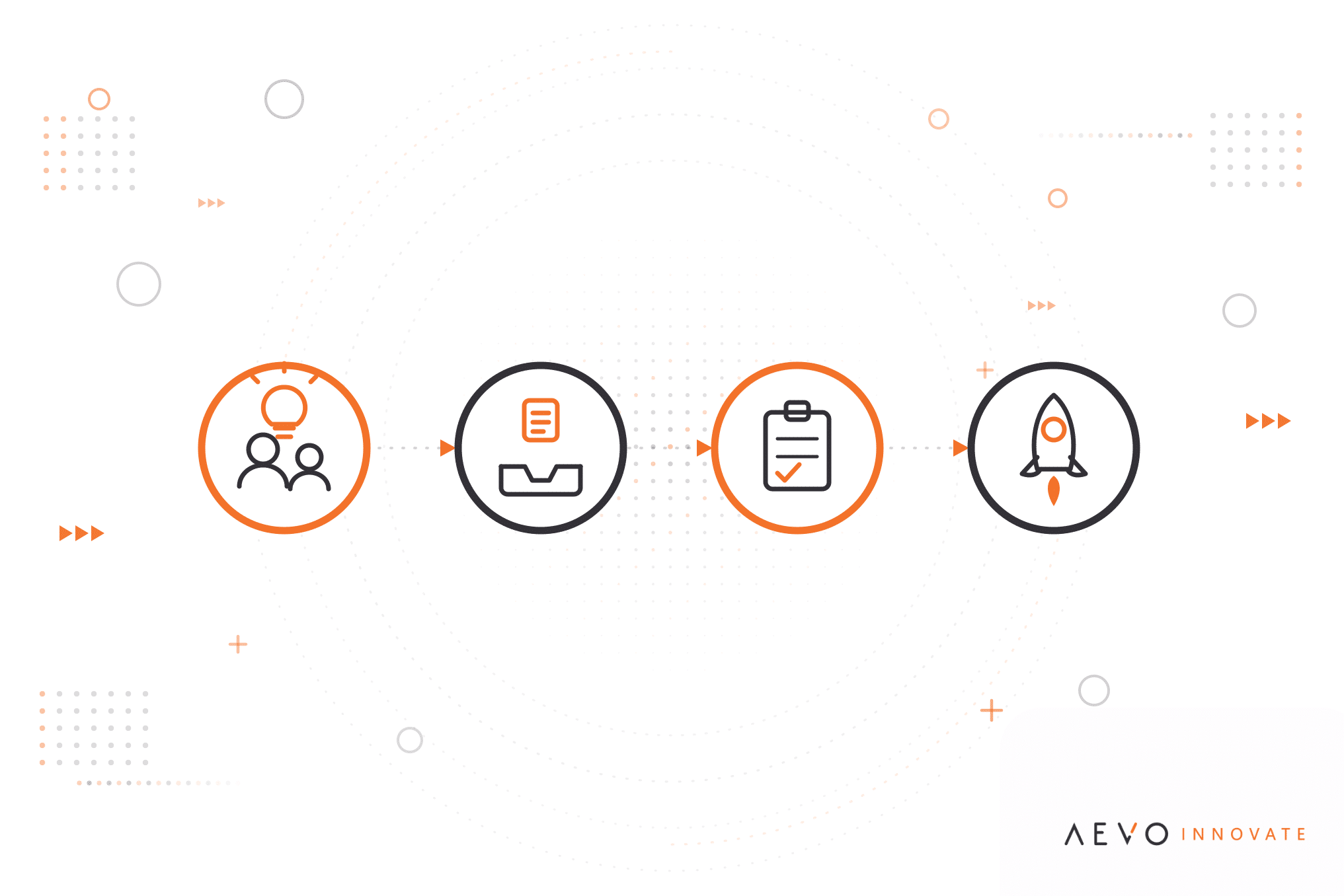
A well-structured innovation funnel helps organizations evaluate ideas consistently, prioritize high-potential opportunities, and transform the best concepts into successful projects. By guiding ideas through three decision gates, Idea Intake, Proposal Submission, and Go Development, companies improve governance, increase transparency, and maximize innovation outcomes.
The innovation funnel is commonly divided into three broad stages:
- Top of the funnel: Idea generation and collection
- Middle of the funnel: Screening, evaluation, and prioritization
- Bottom of the funnel: Development, execution, and implementation
The table below summarizes the role, characteristics, and key metrics of each stage.
| Innovation funnel stage | Main objective | Key characteristics | Example metrics |
| Top of the funnel | Generate and capture a broad range of ideas and opportunities | High volume of contributions, employee engagement, challenge campaigns, external partner participation, idea collection | Employee engagement rate, ideas submitted, ideas per employee, ideas per department, startups registered |
| Middle of the funnel | Filter, evaluate, and prioritize the most promising ideas | Strategic alignment, feasibility analysis, risk assessment, differentiated evaluation criteria, decentralized or committee-based decision-making | Ideas selected, approval rate, approved ideas per campaign, alignment score, evaluation cycle time |
| Bottom of the funnel | Turn selected ideas into projects, implementations, and measurable outcomes | Resource allocation, project development, experimentation, implementation, adoption, ROI measurement | Implementation rate, time to implementation, project ROI, financial gains, cost savings, time to impact |
The three stages are interconnected.
The top maximizes the organization’s ability to identify opportunities.
The middle concentrates attention and resources on the ideas with the greatest potential.
The bottom transforms selected opportunities into implemented solutions and measurable business value.
Let’s explore each stage in more detail.
Top of the innovation funnel
The top stage focuses on generating and capturing a broad range of ideas.
The objective is to create a sufficiently large pool of opportunities before applying more selective evaluation criteria.
In an internal idea program, this may involve employees from different departments, locations, and levels of the organization.
In open innovation, the organization may also involve startups, universities, research institutions, suppliers, customers, and other external partners.
At this stage, companies should focus on making participation accessible and communicating clearly which challenges and opportunities they want to explore.
Employees are often a valuable source of insights because they work directly with customers, products, services, and operational processes.
Strategies for strengthening the top of the funnel include:
- Internal communication campaigns
- Innovation challenges
- Workshops and ideation sessions
- Employee engagement initiatives
- Open innovation calls
- Startup and ecosystem engagement
Platforms such as AEVO Innovate can help organizations structure and manage corporate idea programs, providing a centralized environment for collecting and organizing ideas.
Example top-funnel indicators
- % of employees engaged with the program
- Number of ideas submitted
- Number of ideas submitted per department
- Average ideas submitted per employee
- Number of startups or external partners registered
The following video explains why putting people and their ideas at the center of innovation matters:
Middle of the innovation funnel
The objective is to identify which ideas have sufficient potential to move forward.
The middle stage is where organizations begin to filter, evaluate, and prioritize the ideas collected at the top of the funnel.
Evaluation criteria may include:
- Strategic alignment
- Technical feasibility
- Financial potential
- Customer value
- Implementation complexity
- Risk
- Required resources
The governance model should also reflect the complexity of the idea.
For simple ideas, decision-making can often be decentralized.
For example, a frontline employee may identify a way to modify a machine component to reduce breakdowns. If the change is low-risk and requires limited resources, the decision to implement it may be made locally.
This type of decentralized governance can accelerate Continuous Improvement and reduce unnecessary bureaucracy.
More complex ideas may require evaluation by an innovation committee, R&D team, business unit, or executive leadership because they involve greater investment, uncertainty, or strategic implications.
This distinction is important: the innovation funnel should not necessarily apply the same evaluation process to every idea.
The more mature the innovation program, the more likely it is to differentiate governance and decision-making according to the complexity and potential impact of each opportunity.
Example middle-funnel indicators
- Number of ideas selected for further development
- % of ideas approved vs. submitted
- Approved ideas per campaign
- Average evaluation time
- Strategic alignment score
- Number of ideas rejected or returned for refinement
Bottom of the innovation funnel
At the bottom of the funnel, selected ideas move into development, experimentation, implementation, and measurement.
This is where ideas become concrete innovation projects.
Depending on the initiative, execution may require:
- Securing project funding
- Assigning project owners
- Building prototypes or pilots
- Testing solutions
- Training employees
- Managing organizational change
- Developing a go-to-market strategy
- Scaling successful initiatives
At this stage, the organization needs to shift from selecting opportunities to delivering outcomes.
This is also where innovation ROI becomes particularly important.
ROI can be measured through direct financial returns, cost savings, productivity gains, revenue generation, customer impact, or other relevant indicators.
However, organizations should also monitor the resources and time invested in developing innovation projects.
Example bottom-funnel indicators
- Number of projects implemented
- Implementation rate
- Average time from approval to implementation
- Financial returns
- Cost savings
- Revenue generated
- Innovation ROI
- Time to measurable impact
The bottom of the funnel therefore closes the loop between ideas and results.
The information generated at this stage can also be used to improve future innovation campaigns and evaluation criteria.
nnel, from challenge launch to pilot execution, while connecting with startups through its Connect community.
Innovation funnel vs. innovation stages: what is the difference?
The terms innovation funnel and innovation stages are sometimes used interchangeably, but they describe different concepts.
The innovation funnel is primarily a way to structure the flow of opportunities.
It helps organizations visualize how a large number of ideas can progressively be filtered, prioritized, developed, and implemented.
The innovation stages, on the other hand, describe the maturity or progression of an individual innovation initiative as it moves from one phase to another.
This distinction becomes particularly relevant when discussing Stage-Gate models.
What is Stage-Gate?
Stage-Gate is a structured innovation and product development methodology in which an initiative progresses through a series of stages separated by decision points, or “gates.”
At each gate, decision-makers determine whether the project should:
- Continue
- Be revised
- Be paused
- Be terminated
The model is therefore focused on managing the maturity and development of an individual project or innovation initiative.
The innovation funnel has a broader perspective.
It manages the portfolio flow of multiple ideas and opportunities, helping organizations determine which ones should progress through the pipeline.
In simple terms:
The innovation funnel answers: “Which ideas should move forward?”
Stage-Gate answers: “How should we evaluate and advance an innovation project as it develops?”
The two approaches can therefore work together.
An organization may use an innovation funnel to collect and prioritize ideas and then apply a Stage-Gate methodology to manage the development of selected projects.
The funnel helps manage the quantity and prioritization of opportunities.
Stage-Gate helps manage the maturity, development, and decision-making of individual initiatives.
This distinction is especially useful for organizations that manage both employee-driven innovation and more complex R&D or new product development programs.
Metrics in innovation programs
Whether applied to closed innovation, such as intrapreneurship and internal idea management program, or open innovation involving startups, universities, and other external partners, innovation programs need clear processes and metrics.
Metrics should not be limited to the number of ideas generated.
Organizations should track performance throughout the funnel to understand whether ideas are progressing efficiently and generating value.
Three broad categories are particularly useful:
Volume
Measures the quantity of activity entering the innovation funnel.
Examples include:
- Total ideas submitted
- Ideas per employee
- Number of startups engaged
- Number of participants
- Number of external partners registered
Conversion
Measures how ideas move from one stage to another.
Examples include:
- % of ideas evaluated
- % of ideas approved
- % of ideas implemented
- Ideas submitted per employee
- Conversion rate between funnel stages
Time
Measures the speed of the innovation process.
Examples include:
- Average evaluation time
- Time from submission to approval
- Campaign cycle time
- Time from approval to implementation
- Time to measurable impact
Organizations should combine these metrics rather than focusing on a single indicator.
A high number of ideas is not necessarily positive if few are implemented.
Likewise, a high implementation rate may not indicate success if the initiatives generate little business value.
The most useful measurement systems connect volume, conversion, speed, and outcomes.
Success story: Energisa scales employee-driven innovation
Energisa Group has more than a century of experience in the energy distribution sector and serves approximately 20 million customers, with a network spanning around 700,000 kilometers. With employees distributed across multiple locations, the company needed a scalable way to engage its workforce in innovation.
Innovation has always been part of Energisa’s culture. However, its traditional suggestion box was no longer sufficient to collect and manage ideas across such a geographically distributed organization.
The company initially attempted to develop an internal innovation platform, but the project proved costly and operationally complex. In 2021, Energisa partnered with AEVO to structure its innovation program through a more scalable, robust, and cost-effective solution.
With AEVO, employees gained easier access to the program through a mobile app, while administrators gained greater flexibility to configure approval workflows without relying on IT. Gamification strategies and centralized innovation management also helped strengthen engagement and governance.
The results demonstrate the impact of this transformation:
10,000+ users registered on the AEVO platform
2,000+ ideas submitted in 2023
250+ projects approved in 2023
16× innovation ROI achieved in 2023
Energisa’s experience demonstrates how the right technology can help large, distributed organizations connect employee participation, structured idea management, and measurable business impact, turning a broad pool of ideas into a scalable innovation pipeline.
Success story: Aiwa turns employee ideas into measurable results with AEVO Innovate
The experience of Aiwa, part of Grupo MK, illustrates how a technology-enabled innovation funnel can help organizations move from informal idea collection to a structured innovation program.
Grupo MK founded and has owned the Mondial brand since 2000. In 2020, the group acquired Sony’s electronics factory in Brazil and licensed the AIWA brand, which had belonged to Sony for decades.
Through investments in infrastructure, technology, and communication, combined with consistent manufacturing growth, the group’s brands expanded their presence in the Brazilian market and beyond, including exports to South America.
In April 2024, the Aiwa factory in Manaus began a new phase in its innovation journey.
The organization had already implemented specific projects and was looking for ways to innovate, but it did not yet have a robust, technology-enabled innovation program.
At the time, employees submitted ideas through a physical suggestion box. Ideas were written on paper and deposited into the box.
This manual process created several challenges.
There was no structured approval flow, employees did not have clear visibility into the status of their submissions, and the organization lacked defined metrics to monitor the performance of the program.
The adoption of AEVO Innovate helped transform this process by providing a digital structure for capturing, managing, evaluating, and implementing ideas.
The results included:
- 2,200+ ideas implemented by July 2025
- 8,200+ ideas submitted through the platform
- R$285,000 in financial returns generated in 2024, based on only 5 ideas implemented and measured during the first cycle
- More than R$2 million in potential returns mapped in 2025
The case demonstrates how a Idea Management System can support the entire innovation funnel.
At the top, employees have a simple and accessible way to submit ideas.
In the middle, ideas can be organized, evaluated, and prioritized.
At the bottom, selected initiatives can be implemented and measured based on their results.
As Caio Holanda, Project Analyst and person responsible for the Mentes Kriativas Program, explains:
“I usually say that the platform is one of the pillars of our program: it simplifies the input, submission, and tracking of ideas. Without this technological facilitator, we wouldn’t have the volume we have today or the results that are being achieved.”
The Aiwa example highlights an important lesson for organizations building an innovation funnel: technology does not replace the innovation process, but it can make the process scalable, measurable, and easier for employees to participate in.
Read the full case here: Aiwa Case – From Suggestion Box to Digital Innovation with Million-Dollar ROI
Using the funnel in an idea management program
The innovation funnel can be directly applied to a corporate Idea Management Program.
Top of the funnel
Employees submit ideas through an Innovation Management Platform or other structured channel.
The focus is on participation, accessibility, and capturing a broad range of opportunities.
Middle of the funnel
Ideas are filtered, evaluated, and prioritized according to criteria such as strategic alignment, feasibility, and potential impact.
Simple ideas may be evaluated and approved through decentralized governance, while complex initiatives may require specialized committees or leadership approval.
Bottom of the funnel
Selected ideas become projects and move toward implementation.
The organization tracks execution, measures results, calculates ROI, and captures learnings that can improve future innovation initiatives.
An Innovation Management Platform can help connect these stages in a single environment, providing greater visibility into the movement of ideas through the funnel.
The innovation funnel in open innovation

An Open Innovation Funnel helps organizations accelerate innovation by combining internal expertise with ideas, technologies, and partnerships from external ecosystems. By systematically screening opportunities, collaborating with strategic partners, and scaling validated solutions, companies can reduce time-to-market, improve innovation outcomes, and create sustainable competitive advantage.
The innovation funnel can also be adapted to open innovation programs, where organizations collaborate with external partners such as startups, universities, research institutes, suppliers, and technology providers.
In this context, the funnel may include:
Top of the funnel
The organization launches an innovation challenge and invites external companies, startups, or other ecosystem participants to contribute solutions.
Example indicator: Number of companies or startups registered.
Middle of the funnel
Participants and proposals are screened based on their alignment with the challenge.
The organization may evaluate:
- Solution fit
- Technical feasibility
- Strategic alignment
- Market potential
- Team capabilities
Example indicator: % of aligned companies vs. registered participants.
Bottom of the funnel
The most promising solutions move into deeper evaluation, pitch sessions, partner selection, pilots, and potentially broader implementation.
Through partnerships, organizations can expand their innovation capacity and access capabilities that may not exist internally.
The funnel ensures that this expanded ecosystem does not result in an unmanageable volume of opportunities.
Instead, organizations can maintain a structured process for moving from challenge → external solutions → evaluation → partner selection → pilot → scale.
AEVO Innovate offers modules for open innovation that support companies in managing this journey, from challenge launch to pilot execution, while connecting organizations with startups through its Connect community.
How to build an effective innovation funnel
An effective innovation funnel should be designed around the organization’s strategic priorities, innovation maturity, and available resources.
A practical approach includes five steps:
1. Define innovation objectives
Clarify which business challenges and strategic priorities the innovation program should address.
2. Create accessible channels for ideas
Make it easy for employees or external partners to submit opportunities and solutions.
3. Establish clear evaluation criteria
Define how ideas will be assessed and which criteria determine whether they progress.
4. Differentiate governance by complexity
Use faster, decentralized decision-making for simple improvements and more structured evaluation for complex initiatives.
5. Measure outcomes
Track not only ideas submitted and approved, but also implementation, speed, financial returns, and business impact.
The goal is to create a funnel that is structured enough to support decision-making without becoming so rigid that it slows innovation down.
As BCG has noted in its research on innovation systems, organizations need to rethink innovation as a system that connects strategy, processes, tools, and capabilities.
Here is a quick recap video on the topic:
Conclusion
The innovation funnel provides a practical structure for managing the journey from a large volume of ideas to a smaller portfolio of initiatives with the potential to generate measurable business value.
Its three main stages, top, middle, and bottom of the funnel, help organizations organize idea generation, evaluation, prioritization, development, and implementation.
The model can be applied to internal Idea Management Programs, Continuous Improvement initiatives, intrapreneurship, and open innovation.
However, an effective funnel is not simply about reducing the number of ideas.
It is about making better decisions at each stage.
The top of the funnel creates opportunities.
The middle identifies which ones deserve attention.
The bottom turns selected ideas into implemented solutions and measurable results.
When supported by clear governance, relevant metrics, and technology such as an Innovation Management Platform, the innovation funnel can help organizations create a more structured, scalable, and measurable approach to innovation.
Want to build a more effective innovation funnel in your company? Contact AEVO Innovate’s specialists and request a free demo.